Here is something you have probably noticed but can’t fully explain: your best-ranking pages are getting fewer clicks, yet your pipeline hasn’t collapsed. Branded search is climbing even though you haven’t run a brand campaign. And your sales team keeps hearing “we already know what you do” from prospects who have never visited your website.
This isn’t a reporting glitch. It is what happens when AI starts doing your top-of-funnel work for you inside systems your analytics can’t see.
Search is no longer just about traffic. It is about the influence inside the answer. That is the shift this guide is built around.
Most enterprise marketing teams haven’t caught up to this yet. The prevailing assumption is that AI search is just a more conversational way to return links. This extends to the corollary ChatGPT and Perplexity are basically smarter librarians pointing users to the right website.
Well, they are not!
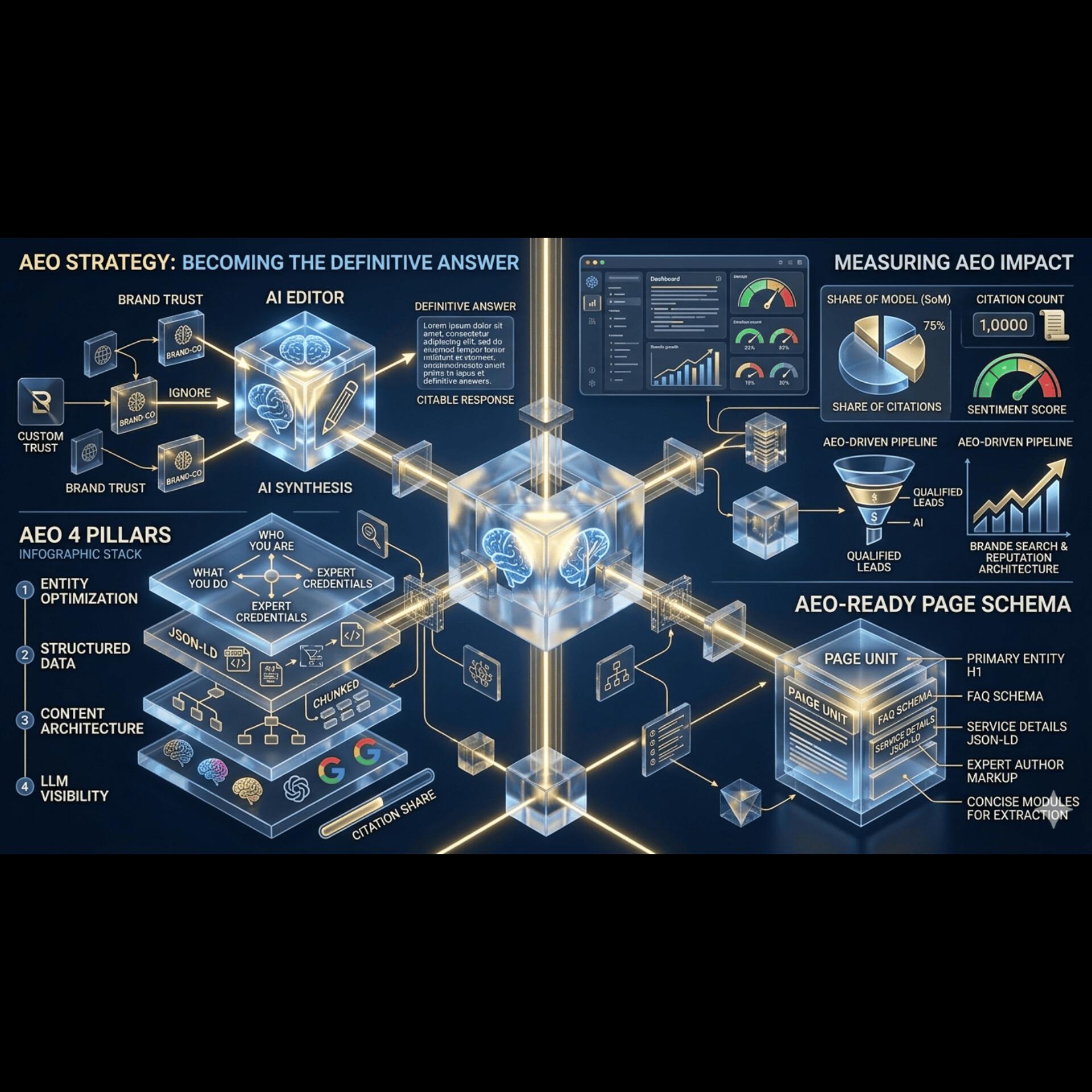
AI search products such as Google’s AI Overviews, ChatGPT Search, Perplexity, and Copilot don’t just retrieve your content. They read it, judge it, and decide whether to include it in the answer they are writing for the user. Think of the model not as an index that ranks your page, but as an editor assembling a briefing. It pulls from your site, your competitors, Reddit, industry publications, and its own training data then synthesizes all of it into a single response. Your content might be one of the sources or it might not make the cut at all.
Getting indexed is no longer the finish line. Getting selected by the editor is.
This means much of the awareness layer, the part of the funnel where a buyer learns what solutions exist, who the credible providers are, and what questions to ask now happens inside the AI before anyone clicks anything. That is why AI-referred traffic, though still small in volume, converts at significantly higher rates than traditional organic. The visitor who does arrive has already been briefed.
And here is what makes this urgent rather than just interesting; these systems learn from patterns. The more consistently your brand shows up as a structured, authoritative source on a topic, the more likely the model is to reference you on the next related query. These compounds. Brands that invest early build a self-reinforcing presence; each citation makes the next one more likely. Brands that don’t invest leave a vacuum that competitors and third-party sources fill. Reddit threads, outdated forum posts, and AI-generated interpretations start defining your brand for you. Those compounds too, just in the wrong direction.
As TOSS the COIN explored in AI-mediated discovery and the death of traffic as a KPI, the old performance model centered on sessions and CTR is no longer a sufficient proxy for brand health. Visibility now happens without a visit, and influence happens without a session. Organizations that continue to measure success purely through traffic metrics risk missing the mark about where the discovery is actually happening.
Answer Engine Optimization (AEO) is not a mere SEO tactic. It is an enterprise visibility system designed for a world where AI curates trust.
This guide breaks down the following questions and concepts:
- What Is Answer Engine Optimization (AEO)?
- Why Must Enterprise Brands Prioritize AEO in 2026?
- The Enterprise AEO Framework (4 Pillars)
- Technical Implementation: The “AEO-Ready” Page Template
- Converting Visibility into Business Outcomes
- Measuring AEO in the Enterprise
- The Future: AEO as Reputation Architecture
What Is Answer Engine Optimization (AEO)?
Answer Engine Optimization (AEO) content to provide direct, concise answers to user queries, targeting position zero in search results and LLMs. It prioritizes conversational, question-based content to enhance visibility in AI-generated summaries.
Unlike traditional SEO, AEO focuses on three layers
- Retrievability
Can AI systems access your content? - Extractability
Can it parse and summarize it? - Trustability
Does it believe you are authoritative enough to cite?
| Feature | Traditional SEO | Answer Engine Optimization (AEO) |
| Primary Goal | Higher SERP ranking and click-throughs | Inclusion in AI-generated answers |
| User Behavior | Keyword-based browsing | Conversational, long-form questioning |
| Content Format | Long-form, hierarchical pages | Concise, modular, “chunked” blocks |
| Primary Metric | Organic Traffic and CTR | Citation Share of Voice and Sentiment |
| Technical Focus | Crawlability and Backlinks | Schema Markup and Entity Building |
In 2026, where zero-click searches have surged to nearly 60% of all queries, AEO is the bridge between a brand and the silent consumer who never leaves the AI interface.
The reality is that SEO, GEO, and AEO are not three separate workstreams to be managed in silos. If your content is semantically tight and your site holds genuine topical authority, it will naturally perform across traditional search, answer engines, and AI-mediated discovery alike. You are building a single, robust information architecture, not running three parallel programs.
We have decoded the core differences between SEO, GEO, and AEO to understand the new frontier of search in depth.
Why Must Enterprise Brands Prioritize AEO in 2026?
Every enterprise marketing team has felt the shift. The dashboards look different than they did 18 months ago, and the old explanations: seasonality, algorithm updates, and competitive pressure don’t fully account for what is happening. The real question isn’t whether AI is changing search. It is whether the change is significant enough to warrant a strategic response at the enterprise level.
It is. And the data makes the case in three ways.
1. The clicks you are losing are not coming back.
This is not a cyclical dip. It is a structural compression in how search delivers value to websites.
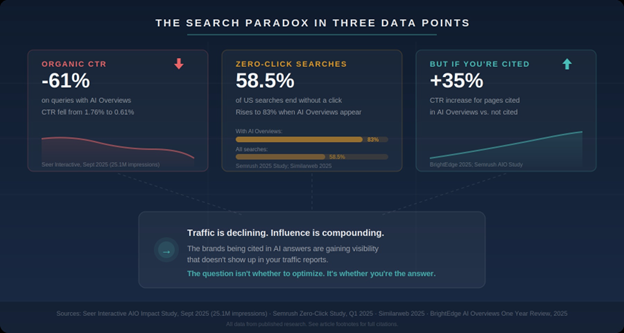
A 2025 study analyzing 25.1 million impressions across 3,119 queries found that organic click-through rates dropped 61% on queries where AI Overviews appeared. However, here is what makes this more than an AI Overviews problem: even on queries without AI Overviews, organic CTR still fell 41% in the same period.
And Semrush’s Q1 2025 zero-click study put a number on it: 58.5% of US searches and 59.7% of EU searches now end without a single click to any external website. When AI Overviews are present, Similarweb data shows that the number rises to approximately 83%. Reshma Budhia, a veteran in the B2B marketing space has helped us unpack what this means for brands that have spent years building their organic traffic. Know more in this interview-style deep dive.
The model that enterprise marketing has operated on for the past 15 years, publish content, rank it, capture the click, nurture the lead, is not broken. The top of that funnel is compressing, and the data suggests it won’t decompress.
The question is not whether your organic traffic will be affected. It is whether you have a strategy for the visibility that now happens before the click. Read more here.
2. The traffic that comes from AI is disproportionately valuable.
Here is where the picture gets more interesting and more strategic than a simple traffic-loss story.
AI-referred traffic is still small in absolute terms. SE Ranking‘s 2025 study across nearly 64,000 websites found that AI platforms account for roughly 0.15% of global web traffic, compared to 48.5% from organic search. And that 0.15% is growing seven times faster than any other referral category!
And the engagement quality is striking: ChatGPT, which drives approximately 80% of all AI referral traffic, sends users who spend close to 10 minutes per session on the sites they visit. Perplexity users an average of around 9 minutes.
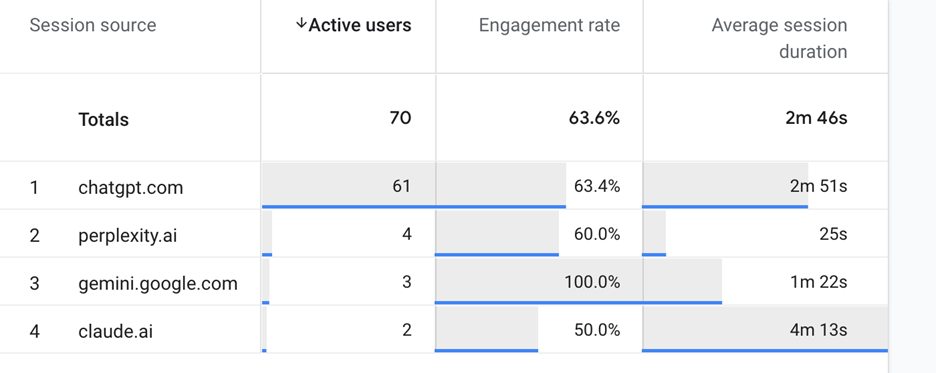
Compare that to typical organic search sessions, and the difference is clear. These are not casual browsers. They are people who received a specific recommendation from an AI system who are now verifying, evaluating, or acting on it.
The Pew Research Center’s March 2025 study, one of the most rigorous behavioral datasets available, tracks 68,879 actual Google searches by 900 US adults. It found that only 8% of users who encountered an AI Overview clicked a traditional search result, compared to 15% when no AI summary was present.
That is significant click reduction.
However, the users who do click through an AI-mediated result are further down the funnel than traditional organic visitors have ever been. The AI has already done the discovery work: defined the problem, compared approaches, and—in many cases—shortlisted providers. The visitor arriving at your site is not starting their research; they are finishing it.
This is the conversion paradox that enterprise marketers need to internalize: total sessions may decline, but the sessions that remain are higher-intent, more qualified, and closer to a buying decision than organic traffic has historically delivered. The metric that matters is shifting from volume to influence.
Consider what happens when your brand is the one the AI cites. Semrush’s analysis found that pages cited within AI Overviews can see CTR increases of up to 35% compared to uncited pages. Being cited doesn’t just maintain your traffic; it can actually increase it relative to competitors on the same query. The brands inside the answer win disproportionately. Everyone else splits what’s left. How AI search engines such as ChatGPT, Perplexity, and Gemini decide what to cite has been explored here.
3. If you are not shaping the AI’s answer, someone else is.
This is the reason that should concern enterprise leadership the most, because it moves the conversation from marketing performance into reputation governance.
AI models don’t leave blanks. When a user asks a question about your category, the model will produce an answer whether your brand has invested in AEO or not. The question is where it pulls its information from.
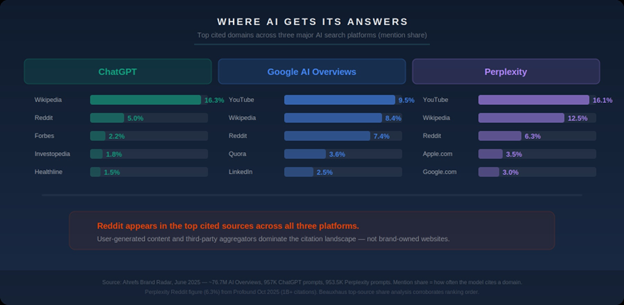
This means that if your owned content isn’t structured and authoritative enough to be selected by the model, your brand’s “AI persona”, the version of your company that appears in AI-generated answers, is being assembled from places you have no control over. These could be Reddit threads, forum complaints, outdated press coverage, competitor comparisons you didn’t write, and whatever Wikipedia says about you.
For a Fortune 500 company that spends millions on brand positioning, that is not a marketing gap. It is a governance failure.
And the compounding dynamic makes the urgency real. AI systems learn from patterns. The more consistently your brand appears as a structured, authoritative source on a topic, the more likely the model is to reference you on the next related query. Brands that wait leave a vacuum that third-party sources fill, and those third-party narratives compound too, just in the wrong direction.
The enterprise brands most at risk are not the ones with bad content. They are the ones with good content buried inside bad structure: locked in PDFs, scattered across microsites, hidden behind JavaScript-heavy frameworks, or written in dense corporate language that machines struggle to parse. The content exists, but AI just can’t get to it.
The Enterprise AEO Framework (4 Pillars)
AEO isn’t a single tactic you bolt onto your existing SEO stack. For enterprise brands, it requires a structural shift in how your website communicates with machines, search engines, LLMs, and AI assistants—not just humans.
This framework breaks that shift into four pillars. Each one builds on the last. Skip one, and the others underperform.
Pillar 1: Entity Optimization
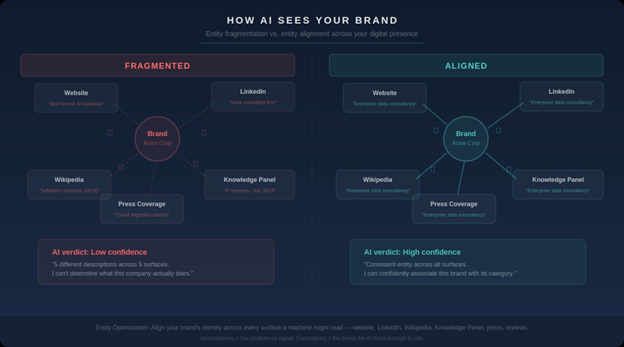
Search engines and LLMs don’t read your website the way a person does. They parse it for entities: people, organizations, products, services, and concepts. Then they try to understand how those entities relate to each other. Entity optimization is about making sure your brand, your offerings, and your subject matter expertise are clearly defined and consistently represented everywhere a machine might look.
This means aligning your website’s copy, metadata, knowledge panels, and third-party mentions around a consistent set of entities your brand should own. If Google or ChatGPT can’t confidently associate your company with the problems you solve, you don’t show up in the consideration set. It’s that binary: The model either sees the connection, or it doesn’t.
And here is where most enterprise brands run into trouble before anything else even matters AI can’t get to their information.
- Core content is buried inside complex PDFs.
- Service pages are rendered through heavy JavaScript frameworks that crawlers struggle with.
- Key facts live in gated resources or scattered microsites with no clear relationship to the main domain.
This isn’t a content quality problem. It is a data readiness problem. If LLM crawlers cannot access your information quickly and reliably, your brand is excluded before the evaluation even begins. You don’t fail the test. You don’t get to take it.
The practical work here is an entity audit. Map every entity your brand should own: your company name, your product names, your service categories, your leadership, and your core expertise areas. Then check whether those entities are consistently defined across your website, your LinkedIn presence, your Wikipedia entry (if you have one), your Google Business Profile, and any third-party platforms where your brand appears. Inconsistency across these surfaces is what creates fragmentation in how AI models represent you.
Pillar 2: Structured Data
Structured data is how you make your content machine-readable at scale. Schema markup such as JSON-LD specifically allows you to explicitly tell search engines and AI systems what your pages are about, what services you offer, what questions you answer, and how your content connects to the broader entity landscape.
For enterprise brands, this goes well beyond basic FAQ or article schema. It means implementing Organization, Service, HowTo, Review, and Event markup across your site in a way that maps to your actual business model. Think of it as the label on the back of the packaging. The customer doesn’t see it, but every system that indexes, categorizes, or surfaces your content depends on it.
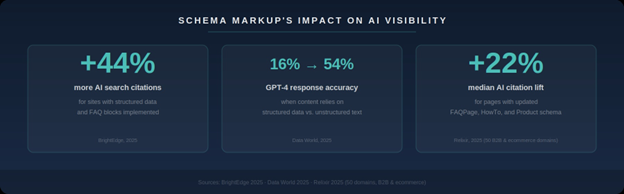
The practical gap for most enterprises isn’t that they don’t have schema. It’s that their schema is shallow, is implemented once during a site build, is never updated, and covers only a fraction of their pages. An AEO-ready site has schema on every service page, product page, key article, and piece of content that answers a question a buyer might ask.
Pillar 3: Content Architecture
Most enterprise websites have good content buried in bad structures. Individual pages might be well-written, well-researched, and even well-optimized for traditional SEO keywords. But they exist in isolation disconnected from related content, orphaned from hub pages, and linked randomly rather than deliberately.
Content architecture is about organizing your pages, blogs, and resources into deliberate topic clusters where every piece of content supports a hub page, every hub page maps to a commercial intent cluster, and every internal link reinforces topical authority. This is how machines map depth.
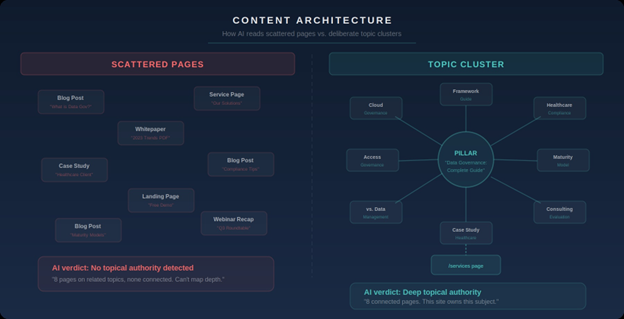
The credibility dimension matters here more than what most enterprise realize.
AI systems don’t just evaluate your content in isolation. They corroborate across your entire digital ecosystem. They compare all these: your website’s content about your expertise, your LinkedIn presence, industry publications about you, third-party reviews, and your leadership team’s published content.
If the signals align, that is, if the entities, the positioning, and the claims are all backed by the same proof points, then the model registers high confidence. If the messaging differs across platforms: one story on LinkedIn, another on your website, a third in press coverage, that’s a low-confidence signal. The model may prioritize a competitor with a more consistent narrative.
The practical work is mapping your content against your actual revenue-driving services and checking whether every high-value topic has a cluster built around it. Not just a single page, but a pillar piece needs to support articles and well-linked resources that together demonstrate depth a that model can recognize.
Pillar 4: LLM Visibility
This is the emerging frontier and the one that ties the other three pillars together. LLMs such as ChatGPT, Claude, and Perplexity are where your buyers start their research. LLM visibility means ensuring your brand shows up in AI-generated answers, not just in traditional search results.
This requires that the first three pillars working in concert”
Entity optimization gets you recognized → Structured data gets you understood → Content architecture gets you trusted.
LLM visibility is the outcome when all three function work together, plus a deliberate strategy around the specific signals LLMs weight when selecting which brands to cite.
This is where specialists outperform generalists. AI models prioritize brands that clearly solve the user’s specific intent cluster.
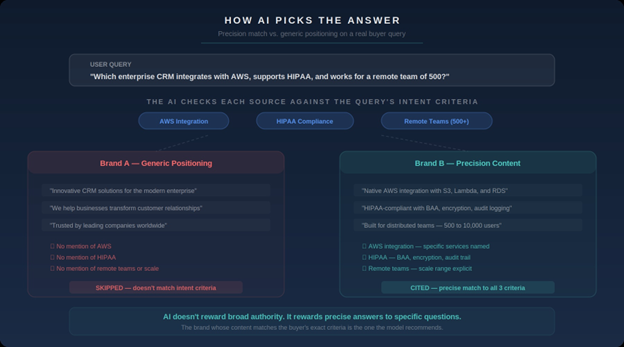
The brand whose content connects its expertise to those measurable, specific business outcomes is the one that the model selects as the best-fit recommendation. The brand that speaks in broad positioning language about “innovative solutions for the modern enterprise” gets passed over.
The practical work here includes building citation-worthy content that answers specific, multi-criteria queries that your buyers ask. It includes maintaining authoritative external mentions, not just backlinks in the traditional SEO sense, but consistent, positive brand mentions across the platforms that these models cite most often. And it includes producing content in the formats LLMs prefer to reference: structured comparisons, clear frameworks, data-supported arguments, and explicit answers, rather than hedged thought leadership.
Technical Implementation: The “AEO-Ready” Page Template
Knowing the four pillars is one thing. Knowing what a page should actually look like when all four are working together is another.
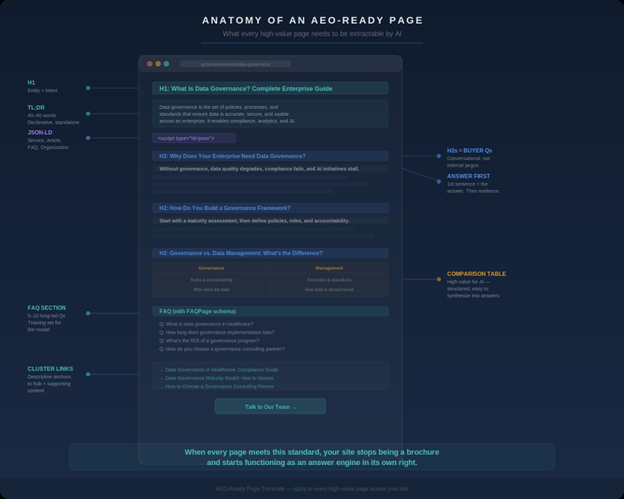
1. A Clear Entity Identity
Every page on your site should answer one question for machines within the first few seconds of parsing: what is this page about, and who is it from? That means your primary entity: whether it’s a service, a product, a solution, or a point of view, needs to be explicitly defined in the page title, the H1, the opening paragraph, and the URL structure. No ambiguity. If a machine can’t identify the core entity within the first 200 words, the page isn’t AEO-ready.
2. Machine-Readable Markup
Behind what the visitor sees, the page needs structured data that tells search engines and LLMs exactly what type of content this is. That means schema markup, typically JSON-LD, embedded in the page header, declaring the entity type (Organization, Service, Article, FAQ, HowTo) and its key attributes. Think of it as a label on the back of the packaging. The customer doesn’t see it, but the system needs it to categorize, index, and surface your content correctly.
3. Intent-Aligned Content Structure
The body content needs to be organized around how people actually search for this topic, not how your internal team describes it. That means headings that reflect real queries, sections that answer specific questions buyers ask at different stages, and a logical flow from problem to solution to next step. Machines reward content that mirrors the structure of the questions being asked. Walls of thought leadership copy with no clear information hierarchy get ignored.
4. Contextual Internal Linking
No page should exist in isolation. Every AEO-ready page links to and from related content on your site: hub pages, supporting blog posts, related service pages, with descriptive anchor text that reinforces the topical relationship. This is how machines map authority. A single well-written page ranks. A well-linked cluster of pages dominates.
When every page on your site meets this standard, your website stops being a brochure and starts functioning as an answer engine in its own right.
Missteps in AEO don’t just result in lower rankings; they result in your brand being completely omitted from AI-generated summaries that now dominate the top of the search results. We have prepared an FAQ-style guide to the most common AEO mistakes and how to steer your enterprise toward visibility.
Converting Visibility into Business Outcomes
TTC’s article “How to Get Content to Convert” emphasizes a key reality: Visibility alone does not drive business outcomes.
AEO must integrate the following:
- Clear next steps
- Decision-stage content
- Objection handling
- Use-case validation
Your AEO strategy should include these kinds of content:
- Comparison pages (“X vs Y”)
- Implementation guides
- Pricing transparency (wherever possible)
- Risk mitigation content
AI may answer the initial question, but deeper decision content must exist for when the buyer engages.
Measuring AEO in the Enterprise
The most common question from CMOs is: “How do I report on this?” Traditional tools such as SEMRush or Ahrefs are only half of the story.
Share of Model (SoM)
SoM is the percentage of times your brand is cited as the solution for a specific query category within an LLM.
- Citation Count
How many times was your brand mentioned? - Sentiment Score
Did the AI recommend you positively, or list you as a “Legacy” provider? - Source Attribution
Is the AI linking back to your whitepaper, or to a Reddit thread about you?
In 2026, we track SoM, the percentage of times your brand is mentioned in a set of 1,000 queries related to your industry across Gemini, Claude, and GPT-5.
- Positive Citations
Your brand is recommended as a solution. - Neutral Mentions
Your brand is listed as a competitor. - Negative Hallucinations
The AI attributes incorrect data to your brand (this requires immediate AEO intervention).
We have also an enterprise AEO glossary, listing 40 terms every CMO must know
Validating AEO: The Invisible Growth Signals
Because AEO often satisfies the user’s intent without a click, we look for secondary signals in traditional analytics to prove the strategy is working. Let’s look at those secondary signals:
- Non-Proportional Branded Traffic Growth
This is a steady rise in the number of users searching for your brand name specifically. This happens because the AI mentioned your brand as a solution, and the user went to Google to find you directly. - “About Us” & “Leadership” Page Spikes
As AI searchers move from “What is the solution?” to “Who can I trust?”, they skip the blog and go straight to your high-authority pages to verify your credentials. - Increased Conversion from Lower Traffic
A characteristic of AEO is seeing a 15–25% drop in total organic sessions while seeing lead quality and conversion rates double. The AI has already performed the “discovery” work, so the visitors who do arrive are hyper-qualified.
The Conversion Paradox
While total website traffic may drop, AI-referral traffic converts at 4–5x the rate of traditional search. Why? Because the AI has already vetted your brand. By the time a user clicks, they are already at the bottom of the funnel.
Sentiment and Semantic Distance
Modern AEO teams use tools to measure how closely their brand is associated with important industry topics. This is often called semantic distance. For example, if your brand focuses on Enterprise Security but AI systems do not strongly connect your brand with AI-Driven Threat Detection, you have an AEO visibility gap. To close that gap, companies publish authoritative content such as whitepapers and research articles that clearly link those two topics together. Over time, this helps AI systems recognize your brand as relevant to both areas.
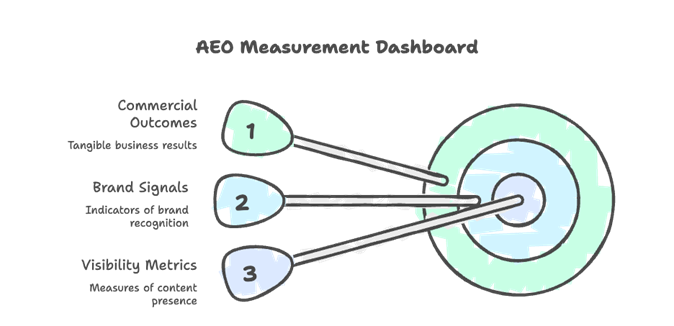
Here’s a practical AEO dashboard structure:
Tier 1: Visibility Metrics
- % inclusion in AI answers (tracked via prompt testing)
- Citation URLs appearing in AI Overviews
- Share of voice for core category definitions
Tier 2: Brand Signals
- Branded search growth
- Direct traffic lift
- Sales mentions referencing content
Tier 3: Commercial Outcomes
- Enterprise MQL growth
- Deal velocity changes
- Content-influenced pipeline
Traffic may decrease, but influence may increase. Executives must understand this nuance.
The Competitive Reality: If You Don’t Own the Answer, Someone Else Will
In AI-mediated environments: The brand that explains the category becomes the category reference.
Smaller competitors can win disproportionate mindshare by resorting to the following actions:
- Writing clearer definitions
- Publishing structured frameworks
- Owning comparison pages
- Creating authoritative glossaries
Enterprise brands often lose because they make these mistakes:
- Hiding clarity behind corporate language
- Publishing vague thought leadership
- Avoiding definitive positioning
AEO rewards decisiveness.
The Future: AEO As Reputation Architecture
The final frontier of AEO is Agentic SEO. Soon, AI agents won’t just answer questions; they will perform tasks.
The Scenario
A user says to their Gemini agent: “Find me a marketing agency that handles international B2B tech rebranding and book a consultation.”
The AEO Requirement
If your brand doesn’t have PotentialAction schema and a clear “Service” entity, the agent cannot complete the booking. You will be skipped for a competitor that is “Agent-Ready.”
The most important shift is to understand that AEO is not about algorithms.
It is about reputation architecture in a machine-mediated world.
Enterprises must ask these questions:
- Are we clear?
- Are we consistent?
- Are we authoritative?
- Are we structurally extractable?
AEO simply ensures that leadership is surfaced inside AI systems.
From Ranking to Being the Answer
The next era of digital visibility is not about climbing SERPs, but about becoming the explanation AI systems trust.
Enterprise brands that dominate AI-mediated discovery will be the ones drive these actions:
- Control their truth layer
- Structure content for extractability
- Amplify authority consistently
- Govern messaging centrally
- Measure influence beyond traffic
Those that cling to traffic as the sole KPI will misread the market. Answer Engine Optimization is the evolution of the internet from a library of pages to a fountain of answers. For enterprise brands, the shift requires moving away from gaming the algorithm and toward educating the AI.
By focusing on entity clarity, structured data, and answer-first content, your brand can move from being searchable to being the answer.
AEO is not optional. It is the next operating system for enterprise brand visibility.
Storyteller