


Other Genres
Other Tags
- #AEO
- #AIEvolution
- #AIInMarketing
- #AIMarketing
- #AISearch
- #AITransformation
- #AnswerEngineOptimization
- #ArtAndEmotion
- #ArtAndLife
- #B2BManufacturing
- #B2BMarketing
- #B2BStrategy
- #BuyerJourney
- #BuyerPsychology
- #ChangingNorms
- #CinematicThinkinginBusiness
- #CMO
- #CMOInsights
- #CognitiveMarketing
- #ComfortZone
- #CompetitiveStrategy
- #ContentthatConnects
- #CreativeBlog
- #CreativeChaos
- #CreativeExpression
- #CreativeJourney
- #Creativeleadership
- #CreativitybuildsConsistency
- #DigitalTransformation
- #EmpathyinLeadership
- #Empowerment
- #EnterpriseMarketing
- #EnterpriseSales
- #EthicsinCommunication
- #EverydayObservations
- #FOEvsFOMO
- #FutureOfSearch
- #GenderBias
- #GenerativeAI
- #GEO
- #GlobalMarketing
- #Gratitude
- #GrowthMindset
- #GrowthStrategy
- #HerStory
- #HiddenFigures
- #ImpactfulStories
- #InclusiveLanguage
- #IndianWomen
- #LeadershipStorytelling
- #LifeLessons
- #LLMSearch
- #MarketingForFounders
- #MarketingLeadership
- #MarketingStrategy
- #MarketingThinking
- #MarktetingConcepts
- #MindsetShift
- #ModernWorkplaceDynamics
- #MomentuminCreativity
- #MultigenerationalLeadership
- #OrganisationalCulture
- #Organisationalmetaphors
- #Perfectionism
- #Personalgrowth
- #PersonalReflection
- #PerspectiveShift
- #PowerOfArt
- #PremiumPositioning
- #Productivity&AI
- #ProfessionalServices
- #Reflections
- #Relatablewriting
- #SearchMarketing
- #SelfBelief
- #SEO
- #SocialCommentary
- #SocialConditioning
- #STEMRoleModels
- #StoriesThatStay
- #StoryBehindStorytellers
- #Storytellers
- #StorytellingforTechnologists
- #StorytellinginMarketing
- #TechnologyTrends
- #ValuebasedPricing
- #VerticalAuthority
- #WomeninHistory
- #WomenInSTEM
- #WorkLife
- #WorkplaceEquity
- #WorkStories
- #ZeroClickSearch
- AI
- Branding
- Culture
- Design
- Elastic Marketing
- Employee Experience
- Employer Branding
- Founder-led Companies
- Gender Bias
- HubandSpoke
- IPO
- LeanMarketing
- Marketing
- Partner Marketing
- soulful stories
- Storytelling
- TosstheCoin

We are having fun with AI. Subscribe here to get a glimpse
Subscribe nowToday, we are diving into a topic that is keeping B2B marketers and SEO strategists up at night: The Zero-Click Search.
As search engines evolve into sophisticated answer engines, the goalpost has moved from simply ranking on the first page to becoming the definitive source of truth that Google, Bing, and AI models cite directly on the results page. For B2B brands, this shift represents a paradox where organic traffic might appear to be declining, while brand influence and authority are actually hitting record highs. Read the comprehensive guide to Answer Engine Optimization (AEO) for Enterprise Brands here. In this interview-style deep dive, we explore the data behind this trend, its impact on the complex B2B buyer journey, and how industry leaders are helping firms pivot from chasing vanity metrics to building mental availability in an AI-first world.
Joining us is Reshma Budhia, a veteran in the B2B marketing space to help us unpack what this means for brands that have spent years building their organic traffic. Let’s start with the basics. What exactly is a zero-click search?
Defining the Invisible Buyer Journey
Saloni: We’ve been hearing a lot about zero-click searches lately. For those who aren’t familiar, what exactly does that mean, and why should B2B companies’ care?
Reshma: Simply put, a zero-click search occurs when a user gets the answer they need directly on the Search Engine Results Page (SERP) without ever clicking on a website link.
Think about when you search for “What is the current exchange rate?” or “Weather in Mumbai,” Google shows you the answer in a box at the top. This is called AI Overviews (AIO. You get what you came for and leave. In the B2B world, this is now happening with complex queries such as “Top CRM features for manufacturing” or “Benefits of offshore marketing pods.”
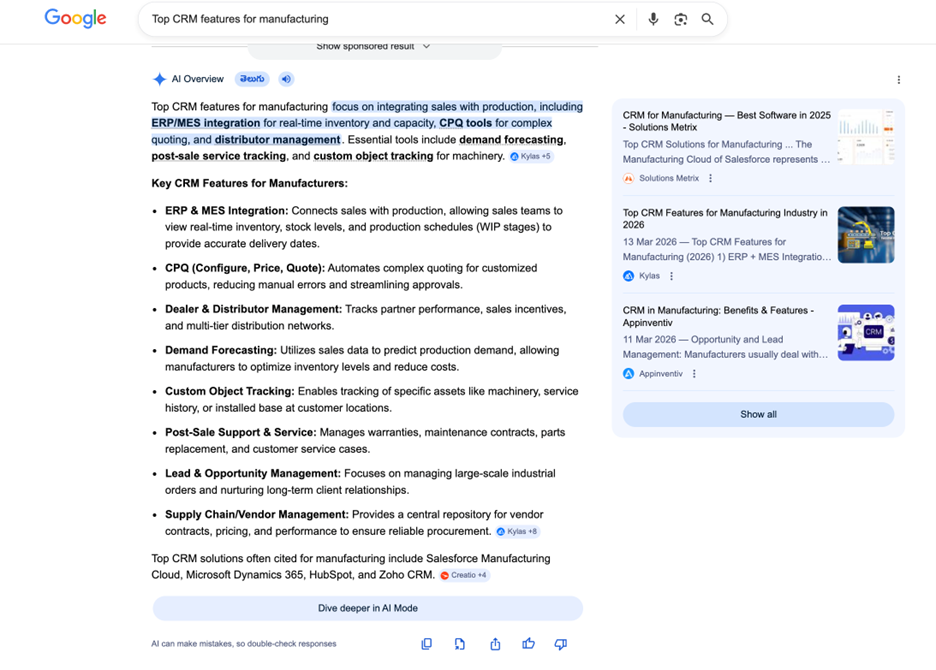
Saloni: So, the search engine is essentially borrowing our content to answer the user?
Reshma: Exactly. Through Featured Snippets, Knowledge Panels, and now AIOs, Google and other engines are becoming answer engines. According to research from SparkToro and Datos, approximately 58.5% of Google searches in the U.S., as of late 2024, ended without a single click. On mobile, that number skydives even further to nearly 77.2%.
For B2B brands, this is a seismic shift. We used to measure success by sessions and page views. Now, a prospect might interact with your brand’s expertise three times in a week through AI-generated summaries and never once land on your blog.
The B2B Stakes: Why Clicks Aren’t Everything
Saloni: If users aren’t clicking, many B2B leaders might think their SEO strategy is failing. Why should they still care?
Reshma: Because while clicks are down, influence is up. In B2B, the buying cycle is long and involves multiple stakeholders. Gartner recently predicted that by 2026, traditional search engine volume will drop by 25% as users migrate to AI chatbots.
If your brand isn’t the one being cited in that AI summary, you’re effectively invisible. This is where Zero-Click Marketing comes in. It’s about creating standalone value on the platforms where your buyers hang out.
The Data: A Reality Check for 2025
Saloni: Let’s look at the numbers. How deep does this impact go for a typical B2B company?
Reshma: The data is quite stark. The ABM Agency reported that between 2024 and 2025, 73% of B2B websites experienced significant traffic loss, with an average decline of 34% year-over-year.
Here are some other critical stats from 2025 reports:
- CTR Collapse
When an AI Overview is present, the organic Click-Through Rate (CTR) for the top position can drop from a standard 15% to just 8%, a nearly 47% reduction (Digital Bloom).
- The Reach Paradox
SparkToro found that posts on social platforms such as LinkedIn get nearly 10 times more reach when they contain no outbound links (zero-click content) compared to posts that try to drive traffic away from the platform.
- Brand Lift
Despite the traffic drop, brands that appear in featured snippets see a 35% improvement in brand recall (Boston Institute of Analytics).
Saloni: That’s a massive trade-off. We’re losing traffic but potentially gaining authority.
Reshma: Precisely. It requires a mindset shift from Traffic = Leads to Influence = Revenue.
Case Study: Turning Visibility into Credibility
Saloni: Can you give us a real-world example of how a B2B brand navigates this?
Reshma: A great example is the Wavicle Case Study by Toss the Coin. They did not just focus on getting clicks to a website that had navigation issues. Instead, they transformed LinkedIn into a growth channel. By focusing on high-value, native content, thought leadership posts and event insights, they achieved 1.4 million impressions and an 11.85% engagement rate.
In a zero-click world, that kind of engagement is the lead generation. By the time a prospect finally visits the site, they are no longer browsing, but already quite convinced.
Strategies to Win (Without the Clicks)
Saloni:
Alright, let’s get practical. If I’m a B2B CMO sitting in the hot seat for 2026, what are my actual marching orders?
Reshma: Honestly? You’ve got to stop obsessing over the “click” and start obsessing over the “answer.” We’re moving from the SEO era into GEO, Generative Engine Optimization. If you want to win this year, your team needs to focus on four things:
- Feed the machine
AI models such as Gemini and ChatGPT are built for structure. If your site is just a wall of text, they’ll skip you. You need Schema markup and FAQ formats so that AI can easily digest and cite your content. At toss the coin, we use our proprietary engine, Ray, to audit content and ensure it aligns with what these models actually look for.
- Claim position zero
You want that featured snippet at the very top. The approach is simple, but the execution is not. In your long-form content, include a clear 40- to 60-word answer right at the top. Give the AI a clean, ready-to-use soundbite.
- Build your entity power
Google doesn’t just rank keywords anymore; it maps entities. That means connecting people, brands, and topics. Get your leadership team’s thinking out into the world—on LinkedIn, in industry journals, and across owned content. When the knowledge graph starts associating your leaders with your category, your brand gains trust as a primary source.
- Rewrite your scorecard
If you’re still measuring success only through site sessions, you’re looking at the wrong metric. Start tracking branded search volume. If people search for your company after seeing you in an AI-generated answer, your strategy is working. You’re building mental availability, not just chasing clicks.
The Future: Building a Defensible Presence
Saloni: Final thoughts? Is the website becoming obsolete?
Reshma: Not at all. Your website is still your digital headquarters. However, it’s no longer the only place your sales pitch happens. As the blog post The Future CRO Is Fluent in Marketing notes, modern B2B buying is 83% independent research.
B2B brands must treat the SERP, LinkedIn, and AI chatbots as their front office. You provide the value there, for free—without demanding a click. By the time the user does click, they are high-intent and ready for a conversation.
If you’re still chasing 2019 traffic numbers, you’re losing. If you build a brand that AI engines want to cite, you win.
Saloni: Thank you for these insights. It seems the coin toss of B2B marketing is no longer about luck, but about being the answer the world is looking for, even if they never visit your home page.
Storyteller



Other posts
-


Sanjana Panchanath
- 18 Mar 2026
- 7 min read
-


Vandana Viswanath
- 16 Mar 2026
- 14 min read
-


Shakti Prasad
- 13 Mar 2026
- 7 min read