

Other Genres
Other Tags
- #AIEvolution
- #AIMarketing
- #B2BManufacturing
- #B2BMarketing
- #B2BStrategy
- #BuyerJourney
- #BuyerPsychology
- #CinematicThinkinginBusiness
- #CMO
- #CMOInsights
- #CognitiveMarketing
- #ComfortZone
- #ContentthatConnects
- #CreativeBlog
- #CreativeChaos
- #Creativeleadership
- #CreativitybuildsConsistency
- #DigitalTransformation
- #EmpathyinLeadership
- #Empowerment
- #EnterpriseSales
- #EthicsinCommunication
- #FOEvsFOMO
- #GlobalMarketing
- #Gratitude
- #GrowthMindset
- #GrowthStrategy
- #HerStory
- #HiddenFigures
- #ImpactfulStories
- #InclusiveLanguage
- #LeadershipStorytelling
- #LifeLessons
- #MarketingForFounders
- #MarketingLeadership
- #MarketingStrategy
- #MarktetingConcepts
- #MindsetShift
- #ModernWorkplaceDynamics
- #MomentuminCreativity
- #MultigenerationalLeadership
- #OrganisationalCulture
- #Organisationalmetaphors
- #Perfectionism
- #Personalgrowth
- #PremiumPositioning
- #Productivity&AI
- #ProfessionalServices
- #Reflections
- #Relatablewriting
- #SelfBelief
- #STEMRoleModels
- #StoriesThatStay
- #StoryBehindStorytellers
- #Storytellers
- #StorytellingforTechnologists
- #StorytellinginMarketing
- #TechnologyTrends
- #ValuebasedPricing
- #VerticalAuthority
- #WomeninHistory
- #WomenInSTEM
- #WorkLife
- #WorkplaceEquity
- #WorkStories
- AI
- Branding
- Culture
- Design
- Elastic Marketing
- Employee Experience
- Employer Branding
- Founder-led Companies
- Gender Bias
- HubandSpoke
- IPO
- LeanMarketing
- Marketing
- Partner Marketing
- soulful stories
- Storytelling
- TosstheCoin

We are having fun with AI. Subscribe here to get a glimpse
Subscribe nowHere is a paradox playing out across B2B SaaS and IT services right now: traffic is down, click-through rates are declining, and yet enterprise deals are growing.
Dashboard metrics suggest one thing. Pipeline performance indicates another.
Clickthrough rates (CTRs) have dropped by as much as 58% on queries where AI overviews appear. Nearly 60% of all Google searches now end without a single click. Marketing teams are watching traffic reports flatten or decline and bracing for the pipeline impact that should follow.
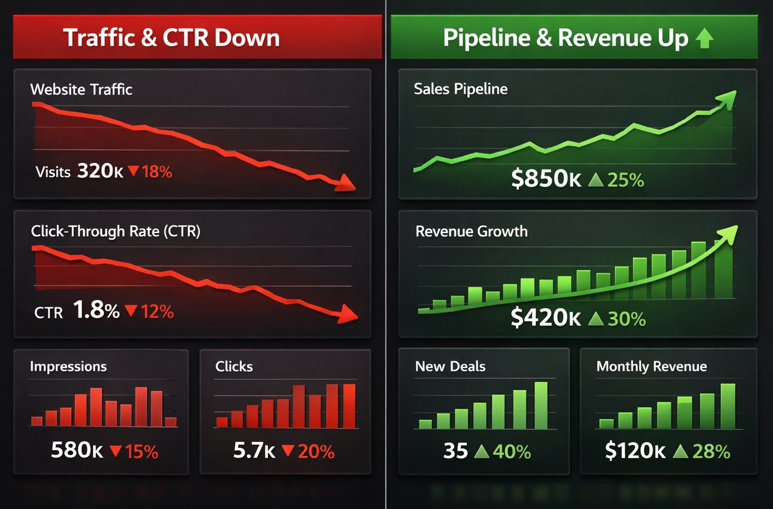
For some companies, that impact never comes. Instead, they are seeing stronger inbound from enterprise buyers. Deals are appearing from prospects who never filled out a form, never clicked an ad, and never appeared in the attribution model.
What is happening?
The answer is simple but disruptive: traffic no longer explains growth.
The Signal That Stopped Signaling
For years, traffic worked because it represented something real. A human clicked. A human chose your brand. A human entered your ecosystem.
Traffic signaled intent. More traffic suggested broader awareness, expanding demand, and increasing surface area.
It was not perfect, but it correlated.
Today, that correlation is weakening. Not because demand has disappeared, but because discovery has changed shape.
The data tells a stark story: According to a 2025 Pew Research study, click-through rates plummeted to just 8% when an AI Overview was present, compared to 15% for traditional search results. That is a 47% reduction. And of those who see an AI-generated summary, only 1% click through to the cited sources. By late 2025, Ahrefs found AI Overviews reduce organic CTR for top-ranking content by 58%.
Nearly 60% of all Google searches now end without a click. For searches involving AI summaries, that zero-click rate climbs to 83%.
Clicks are not disappearing because people stopped searching. They are disappearing because people no longer need to click.
Where Influence Actually Happens Now
Search did not die; it evolved from a referral engine into an interpretation layer.
The old model was simple:
Query → List of links → Click → Research.
Today the journey looks different:
Query → AI summary → Structured comparison → Framed narrative → Shortlist
All before a single click happens.
That shift sounds subtle. It isn’t.
It means influence can occur without traffic. Evaluation can happen before engagement. Shortlisting can happen invisibly. Traffic only measures the moment someone enters your site. AI-mediated discovery shifts influence upstream before that moment.
And if you are measuring success by sessions alone, you are measuring the aftermath, not the action.
The Assumptions That Are Quietly Breaking
Most growth systems still operate on assumptions that made sense in 2018—traffic growth equals demand growth. Rankings equal visibility, which equals influence. Clicks equal intent. Attribution equals last interaction.
In an AI-mediated environment, none of those are reliably true.
You may be cited in AI summaries, compared in automatically generated tables, described in AI-generated overviews and never receive the click. You influenced the decision, but analytics didn’t record it.
This is a specific manifestation of a broader problem I have explored in depth: Why channel-first marketing is quietly failing. When we over-index on channel performance metrics—whether traffic, impressions, or clicks—we mistake the delivery mechanism for the outcome itself.
What This Looks Like in Practice
Consider a VP of Engineering researching enterprise DevOps partners for financial services.
An AI summary mentions three firms, summarizes strengths, and frames differentiators. Your company appears. The VP notes your name, searches your brand directly a week later, speaks with a peer at a conference, and engages months later through an outbound reply.
In your CRM, the opportunity appears as Direct, Referral, or Outbound.
Traffic did not signal discovery, but discovery happened.
If your KPI is traffic, you’ll conclude SEO underperformed. When in reality, your influence increased.
This isn’t hypothetical. According to 6sense 2025 research, 81% of B2B buyers choose their vendors before sales contact, and 95% of the time, the winning vendor is already on the buyers’ day-one shortlist. Forrester’s 2024 Buyers Journey Survey found that 92% of B2B buyers start their journey with at least one vendor already in mind.
The battle isn’t being won on your website. It is being won in the moments of AI-mediated research that preceded the click.
Why Pipeline Feels Volatile When Traffic Feels Flat
For mid-market firms scaling from $10M to $100M, this creates a particular kind of confusion.
Impressions may rise. Rankings may hold. Traffic may flatten. Sales cycles may stretch. Close rates may fluctuate. The numbers don’t tell a coherent story anymore because the story has moved upstream.
Traffic is no longer predictive of pipeline reliability. And pipeline volatility feels like execution weakness when it is actually signal distortion.
Gartner reports that B2B buyers now go through an average of 27 touchpoints before a purchase decision, distributed across different channels, devices, and times. Meanwhile, 61% of B2B marketing managers say they have no clear view of the customer journey. The fragmentation is real, and traditional metrics were not designed to capture it.
The Deeper Economic Shift
Here is what’s really happening beneath the surface.
AI lowers the cost of information production. It also lowers the cost of comparison. Buyers can evaluate multiple vendors faster, synthesize complex topics instantly, and shortlist without visiting ten websites.
The result? More informed buyers. More cautious buyers. More compressed evaluation cycles but longer internal decision cycles. Forrester found that 86% of B2B purchases stall during the buying process, and the average B2B buying cycle now stretches to 11.5 months and over 16 months for large multinational deals.
Traffic doesn’t capture that nuance. Lifecycle movement does.
What Should Replace Traffic As a KPI
Not vanity metrics. Not vague brand sentiment. But lifecycle-oriented signals that track actual buyer behavior.
Stage Progression
How quickly are prospects moving through your pipeline stages, and what content correlates with that movement?
Content-Assisted Opportunity Creation
Which pieces of content appear in the journey of opportunities that close, regardless of whether they drove the initial click?
Exposure-to-Meeting Time
How long did it take between the first documented brand exposure and first sales conversation? Is that window compressing or expanding?
Sales Cycle Compression
Are deals that engage with your content closing faster than those that don’t?
Pipeline-Influenced vs Pipeline-Sourced
A piece of content may not have generated the lead, but it may have influenced the close.
The question should not be “How much traffic did we generate?” It should be “Did this content change buyer behavior?”
This Does Not Make SEO Obsolete
Topical authority still matters. Content depth still matters. If you are not publishing consistently, you won’t appear in AI summaries. Research shows that only 12% of URLs cited by ChatGPT, Perplexity, and Copilot rank in Google top 10 search results, meaning AI systems are pulling from a broader content landscape than what traditional rankings suggest.
However, SEOs job is evolving: from traffic generation to credibility infrastructure and from volume engine to influence surface area.
Traffic now tells you whether you are visible. It does not tell you whether you are decisive.
The Choice Ahead
If you are a CEO or CMO in IT services or SaaS, the question shouldn’t be “How do we get traffic back?”
It should be “How do we design content that influences decisions before clicks?”
Because in this next phase of growth, presence matters, narrative matters, and authority matters but clicks may not.
The companies that will win in this landscape are the ones rethinking measurement itself. They are asking new opportunities how they first heard about the company and not just checking the CRM source field.
They are tracking brand recall in sales conversations alongside traffic reports. And they are discovering what many marketing teams are just beginning to suspect—a significant portion of their pipeline comes from prospects who kept seeing the company show up during research but couldn’t point to a specific click.
That is the invisible influence that traffic can’t capture. And it is the influence that will determine which companies win in an AI-mediated discovery landscape.
If you are still measuring success by sessions alone, you may be optimizing the wrong lever entirely.
Storyteller



Other posts
-



Malavika Mahendranath
- 20 Feb 2026
- 3 min read
-


Anjana Selvaraj
- 20 Feb 2026
- 2 min read
-


Vandana Viswanath
- 20 Feb 2026
- 5 min read