

I have forgotten ABC… not because my kids grew out of the nursery, but because the only letters I have been reading are AEO, GEO, RAG, SEO, LLMsetc.
As I am trying to familiarize clients with these new abbreviations and AI terms, in my effort to help them with their AI visibility journey. That’s how I started to list down the terms that hit my eyes every day. Here is my initial list.
This categorized reference guide breaks down the 40 essential terms that define the modern AEO landscape.
Category 1
The Foundations of Answer Engines
These terms define the infrastructure of how AI understands your brand.
- Answer Engine Optimization (AEO)
AEO is the process of optimizing content so that AI-powered engines (such as Google Gemini, Perplexity, and ChatGPT) select and present your brand’s information as the definitive answer to a user’s query. Read our in-depth, comprehensive guide The Definitive Guide to Answer Engine Optimization (AEO) for Enterprise Brands.
- Generative Engine Optimization (GEO)
This is a subset of AEO that’s specifically focused on influencing the outputs of Generative AI models. It emphasizes technical transparency and citation-ready content. To learn more about the differences between GEO, AEO and SEO read our blog post, The New Frontier of Search.
- Large Language Model (LLM)
The underlying AI (such as GPT-4 and Claude) trained on massive datasets to understand, summarize, and generate content that comes close to human-written text. For a CMO, the LLM is the gatekeeper to your audience.
- Retrieval-Augmented Generation (RAG)
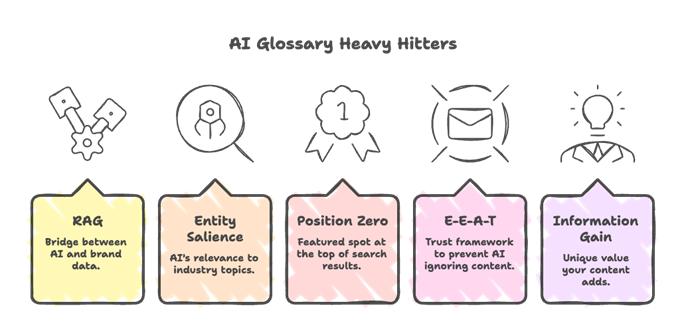
RAG is a framework that allows an LLM to retrieve facts from an external, trusted knowledge base (like your company’s website) before generating an answer. This reduces hallucinations and ensures accuracy. Know more on this here.
- Knowledge Graph
This is a programmatic map of interconnected entities (people, places, brands, and products). AEO aims to place your brand firmly within Google’s Knowledge Graph to ensure the engine knows who you are.
- Entity-Based Search
This search is the shift from matching keywords to understanding entities. AI doesn’t just look for the word Cloud Computing; it looks for the relationship between your brand and the concept of Cloud Computing.
- Tokenization
This is the process of breaking text into smaller units (tokens) for AI processing. Understanding how your technical content is tokenized helps in optimizing for LLM clarity.
- Training Data
This historical data is used to build an AI. CMOs must ensure their high-value whitepapers and case studies are accessible to the web crawlers that feed these datasets.
Category 2
Technical Infrastructure & Structure
These terms show concepts that are the bones of your AEO strategy. If the machines can’t read you, they won’t cite you.
- Schema Markup (Structured Data)
This is standardized code (Vocabulary from Schema.org) placed on your website to help answer engines understand the context of your data: such as prices, reviews, or executive bios.
- JSON-LD
JSON-LD is the preferred format for implementing Schema. It is the language that helps AI agents parse the information on your website without having to guess the context.
- API-First Content
Delivering content through Application Programming Interfaces helps third-party AI assistants and voice bots ingest it easily.
- Semantic HTML
Using HTML tags (like <article>, <section>, and <header>) provides structural meaning to web pages, making it easier for AI to chunk your content for summaries.
- Sitemap.xml
While an old SEO staple, in AEO, a clean sitemap is the map that tells AI crawlers which version of your data is the source of truth.
- Robots.txt for AI
The file used to manage AI crawlers (such as GPTBot). This allows or disallows crawlers access to your content. CMOs must balance data privacy with the need for AI visibility.
- Canonical Tags
These are tags that tell AI which version of a page is the original. This prevents source dilution where an AI might get confused by duplicate content.
- Web-Scale Discovery
This is the ability for your brand’s assets (such as PDFs, Videos, or Podcasts) to be found and indexed across the entire web, not just on your primary domain.
Category 3
Authority, Trust, & E-E-A-T
In the age of AI-generated noise, trust is the only currency that matters.
- E-E-A-T (Experience, Expertise, Authoritativeness, Trustworthiness)
This is the cool acronym for Google’s framework for evaluating content. In AEO, AI models prioritize sources that demonstrate high E-E-A-T, especially in “Your Money or Your Life” (YMYL) industries.
- Digital Footprint
This footprint is the collective presence of your brand across social media, PR, and third-party sites. A wide, consistent footprint helps AI verify your brand’s claims.
- Citation Velocity
Citation Velocity is the rate at which third-party authoritative sites cite your brand. High velocity signals to AI that your brand is a trending authority.
- Niche Authority
This is a metric of how deeply your brand is associated with a specific, narrow topic. AI engines prefer experts over generalists.
- Sentiment Analysis
This is the process by which AI determines if the mentions of your brand across the web are positive, negative, or neutral. This directly impacts whether an AI recommends you.
- Brand Salience
This is how often your brand is mentioned in relation to specific problem-solving queries. If a user asks, “How do I secure my remote workforce?”, high salience means the AI mentions your software.
- Information Gain
A crucial AEO concept, information gain refers to the unique, original data your content provides that isn’t found elsewhere. AI rewards content that adds new value rather than repeating existing summaries.
- Social Proof Integration
Social Proof Integration helps ensure that reviews, testimonials, and case studies are structured such that AI can extract them as proof of your brand’s efficacy.
Category 4
Content Strategy for the Answer Era
Here’s how you can write for both humans and machines.
- Zero-Click Content
This is content designed to provide full value directly on the platform where it lives (LinkedIn, SERP, or Twitter) without requiring a click-through. Learn more here, A B2B Survival Guide: The Zero-Click Search Revolution.
- Conversational Keywords
These are long-tail phrases that mimic how people speak to voice assistants (e.g., “What is the best way to…?” instead of “The best way…”).
- Fragmented Content Design
Breaking your long-form content into snackable nibbles can help AI easily pull it into a “Featured Snippet” or “AI Overview.”
- Thought Leadership Synthesis
This is the process of using proprietary data and executive opinions to create uncopyable content that AI models use as primary sources.
- The “Answer First” Format (Or The Inverted Pyramid)
This is the basic rule of news writing: the style in which the direct answer to a query is provided in the first 50 words, followed by supporting details. This helps the most important content make the cut.
- Question-Based Headings
Using H2 and H3 tags as specific questions signals to an answer engine exactly what the following text is answering.
- Multi-Modal Content
Creating content in various formats (video, text, or audio) simultaneously helps. AI models are increasingly multi-modal. They may use a video transcript to answer a text query.
- Evergreen Accuracy
This is the practice of constantly updating foundational content. AI engines penalize outdated facts in favor of real-time accuracy.
Category 5
Measuring AEO Success (The New ROI)
Traditional traffic metrics are dying. Here is what to track instead.
- Share of Model (SoM)
SoM is a new metric that measures how often your brand is mentioned by specific AI models compared to your competitors.
- Impression Volume in AIO
Impression volume tracks how many times your brand appears in AI Overviews on Google, even if no click occurs.
- Branded Search Volume
This is the number of users searching for your brand specifically. High-branded search is a sign that AEO is building Mental Availability.
- Citation Count
Citation count monitors how many times an AI model links to your site as a source for its generated answer.
- Voice Search Rank
This ranking shows where your brand sits in the Position Zero spot for voice-activated queries (such as Alexa, Siri, or Google Assistant).
- Conversion Quality (Post-AEO)
Post-AEO measures the intent of users who do click. Usually, AEO-driven traffic is higher intent because the user has already been pre-sold by the AI’s summary.
- Generative Visibility Score
This is the aggregate score of your brand’s presence across multiple generative search platforms.
- Cost per Answer (CPA)
This is a shift from Cost per Click (CPC). CPA measures the investment required to own the definitive answer for a high-value category query.
The Mandate My Team Gave Me
For the modern Enterprise CMO, the “The Enterprise AEO Glossary” is the roadmap for the next five years of digital marketing. The transition from SEO to AEO is a transition from visibility to authority.
As search engines stop being phone books and start being consultants, your brand must ensure that it is the expert the consultant recommends. By implementing the strategies behind these 40 terms, your organization can move beyond the click crisis and thrive in the Answer Engine era.
Storyteller