

Other Genres
Other Tags
- #AIEvolution
- #AIMarketing
- #B2BManufacturing
- #B2BMarketing
- #B2BStrategy
- #BuyerJourney
- #BuyerPsychology
- #CinematicThinkinginBusiness
- #CMO
- #CMOInsights
- #CognitiveMarketing
- #ComfortZone
- #ContentthatConnects
- #CreativeBlog
- #CreativeChaos
- #Creativeleadership
- #CreativitybuildsConsistency
- #DigitalTransformation
- #EmpathyinLeadership
- #Empowerment
- #EnterpriseSales
- #EthicsinCommunication
- #FOEvsFOMO
- #GlobalMarketing
- #Gratitude
- #GrowthMindset
- #GrowthStrategy
- #HerStory
- #HiddenFigures
- #ImpactfulStories
- #InclusiveLanguage
- #LeadershipStorytelling
- #LifeLessons
- #MarketingForFounders
- #MarketingLeadership
- #MarketingStrategy
- #MarktetingConcepts
- #MindsetShift
- #ModernWorkplaceDynamics
- #MomentuminCreativity
- #MultigenerationalLeadership
- #OrganisationalCulture
- #Organisationalmetaphors
- #Perfectionism
- #Personalgrowth
- #PremiumPositioning
- #Productivity&AI
- #ProfessionalServices
- #Reflections
- #Relatablewriting
- #SelfBelief
- #STEMRoleModels
- #StoriesThatStay
- #StoryBehindStorytellers
- #Storytellers
- #StorytellingforTechnologists
- #StorytellinginMarketing
- #TechnologyTrends
- #ValuebasedPricing
- #VerticalAuthority
- #WomeninHistory
- #WomenInSTEM
- #WorkLife
- #WorkplaceEquity
- #WorkStories
- AI
- Branding
- Culture
- Design
- Elastic Marketing
- Employee Experience
- Employer Branding
- Founder-led Companies
- Gender Bias
- HubandSpoke
- IPO
- LeanMarketing
- Marketing
- Partner Marketing
- soulful stories
- Storytelling
- TosstheCoin

We are having fun with AI. Subscribe here to get a glimpse
Subscribe now(Part 2 of a Multipart Series
History’s Hidden Figures: The Women We Were Made to Forget)
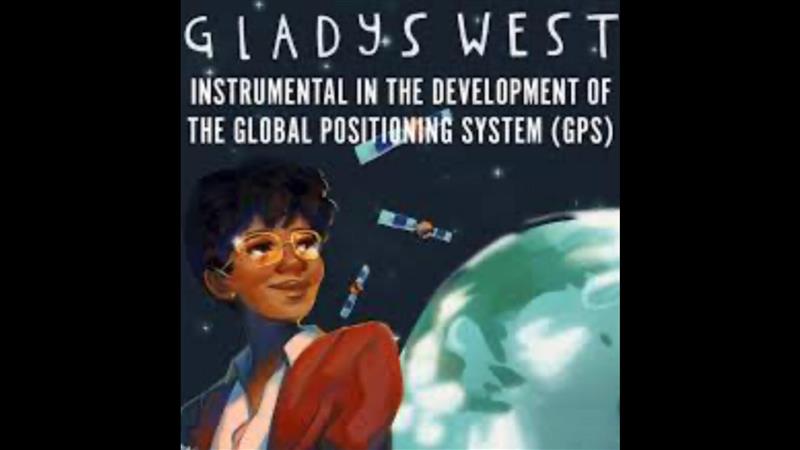
You couldn’t find your way around town without Dr. Gladys West.
Every time you open a map on your phone, every time your Uber arrives at your exact doorstep or your plane lands safely in low visibility, you are following a path she laid down decades ago—long before satellites rolled over our heads, before GPS became a verb.
Dr. West did not hold a transmitter or launch a rocket. She held a pencil, and then a punch card, but always a vision “…to set an example for other people who were coming behind me, especially women.”
Gladys computed the Earth into shape. For most of her life, no one knew her name. Neither did I… until I saw her obituary on January 17, 2026, when Dr. West died at 95. I had to read more about her. I had to write about her.
From Tobacco Fields to the Stars
Dr. West was born as Gladys Mae Brown in 1930 in a Black farming family in Virginia, USA. Her parents owned a small farm and worked in it, as did young Gladys. The future, as it appeared to most girls around her, offered two paths: continue working the land or join the tobacco plant nearby.
Little Gladys had a third option, though: She had a mind for numbers.
At school, her teachers noticed her speed and precision. Gladys graduated high school as valedictorian and with a full scholarship to Virginia State University.
After graduating in Math in 1952, Gladys taught in segregated Virginia schools, trying for good government jobs that repeatedly went only to white men. After her master’s in 1955 too, the doors stayed shut for her… until 1956. Doors have a habit of eventually cracking open for those who try!
The Fourth Black Employee at Dahlgren
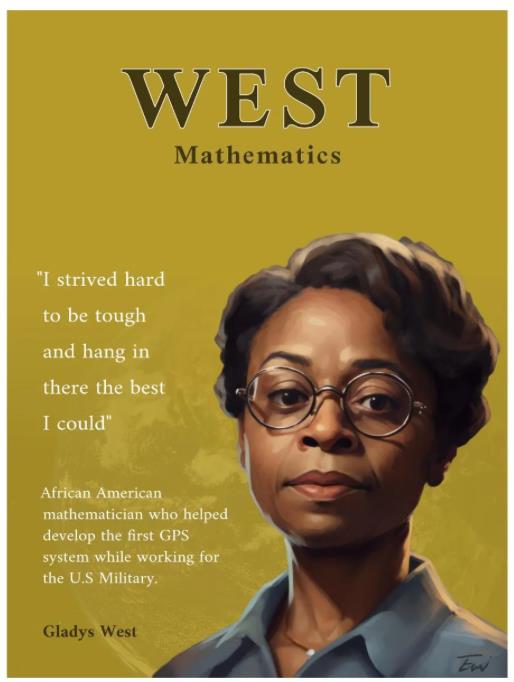
The Naval Proving Ground in Dahlgren, Virginia, was a weapons laboratory—a place where mathematics met national defense. In 1956, when Gladys Mae Brown walked in, she became the fourth Black employee on the base.
There, quietly, relentlessly, Gladys began to change the world. An era before desktop computing, she could solve complex equations, just pencil on paper. But soon, the machines arrived. And she learned to transition.
One of Gladys’s major projects involved the Naval Ordnance Research Calculator (NORC), an early supercomputer that determined the movements of Pluto in relation to Neptune. The calculations ran into hours, and every result had to be double-checked by hand. She kept checking… for decades. Oh, there she also met mathematician Ira West, married him, and went on to raise three children with him.
The Satellite That Saw the Sea: Seasat
In 1978, Gladys became project manager for Seasat, an experimental work on an ocean surveillance satellite, the first of its kind. Its mission was to observe Earth’s oceans from space, measuring wave height, water temperature, currents, winds, icebergs, and coastal features.
Seasat proved that satellites could do more than observe space; they could look down to Earth. West’s most consequential work was in 1985: a project called GEOSAT.
Her goal was audacious: program a satellite to create a computer model of Earth’s entire surface, not just its mountains and valleys, but the subtle, shifting shape of the planet itself. West and her team taught the computer to account for gravity, tides, and other forces acting on the Earth’s surface. They programmed it to calculate satellite orbits with extreme precision.
GeoSat and Geoid
From the calculations of Gladys’s team, something revolutionary emerged: a model for the exact shape of Earth, called a geoid. That model laid the foundation of the Global Positioning System (GPS).
Every time your phone checks your location, this is what it is actually doing. It is consulting a geoid—a mathematical map of the planet’s contours—that traces its lineage directly back to Gladys work.
She mapped the Earth so satellites could find it. And she did it while the world looked outward.
In 1973, Gladys picked up another master’s degree in public administration. In 1986, she co-authored a technical report titled “The Effect of the Earth’s Gravity on Satellite Orbits”—a humble and drab title for foundational science.
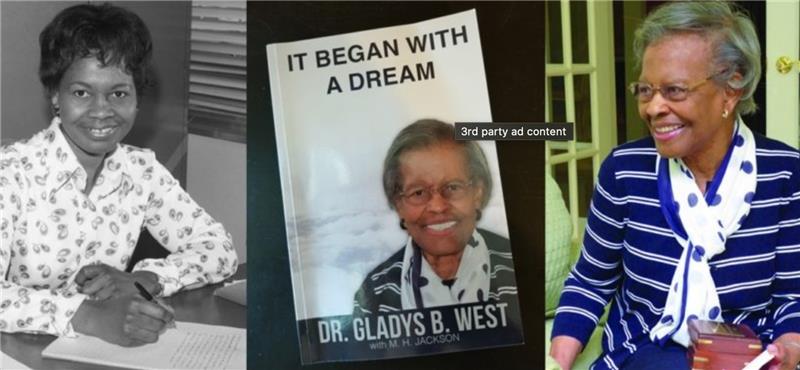
Though she retired from the naval base in 1998 at age 68, Gladys West was not built for still life. In 2000, aged 70, she acquired a Ph.D. in public administration.
A Hidden Figure, Finally Seen
Much like Katherine Johnson, Dorothy Vaughan, and Mary Jackson (her contemporaries at NASA on whom the movie was made), Gladys West spent decades in the shadows of history. The work was classified, technical, and unglamorous. No name or photographs in newspapers… No awards at her desk, but she kept on working.
Recognition, however faint, finally arrived. In 2018, the Virginia General Assembly formally honored her contribution to GPS. That same year, she was inducted into the Air Force Space and Missile Pioneers Hall of Fame and named one of the BBC’s 100 Women of 2018, a list honoring inspiring women. She was 88.
The Mapmaker’s Legacy
When Dr. West passed away on January 17, last month, obituaries noted her place among the pioneers in geosciences. But obituaries are short and fleeting. They cannot contain the scale of the work she did. Science ought to have honored her better.
Gladys made GPS possible. She did not launch satellites but showed them where to go. Without seeking fame, she earned it—may be decades late but not denied.
“You’re always competing and trying to survive because you’re in a different group of people.”
— Dr. Gladys West
https://www.bbc.com/news/world-43812053
https://www.britannica.com/biography/Gladys-West
https://www.nytimes.com/2026/01/27/science/gladys-west-dead.html
Storyteller


Other posts
-


Malavika Mahendranath
- 20 Feb 2026
- 3 min read
-


Anjana Selvaraj
- 20 Feb 2026
- 2 min read
-


Shakti Prasad
- 20 Feb 2026
- 7 min read