I am not a developer. I studied marketing.
When I started an internship with Toss the Coin, I expected campaigns, content, and strategy. Instead, I ended up building a web application. This surprised me more than anyone else.
The Problem That I Couldn’t Unsee
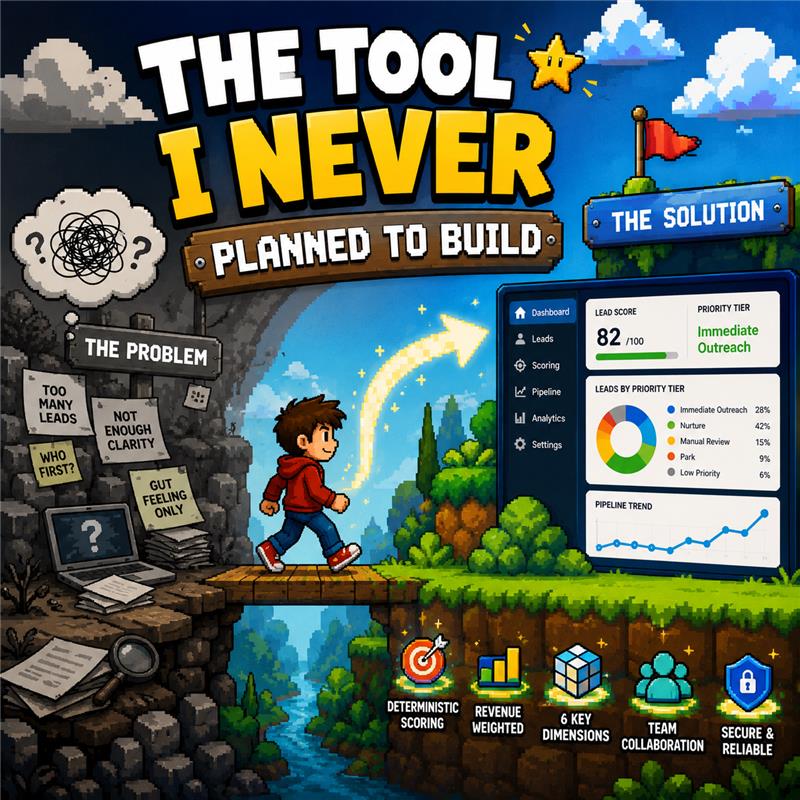
Every B2B service company quietly deals with their prime problem, lead prioritization. So I built a web-based lead intelligence system that helps B2B teams or companies identify, score, and prioritize their leads systematically. I want to be clear that my tool was not about rejecting leads. In the B2B space, a single client can mean months of revenue. Every lead matters, but not every lead is ready at the same time. Knowing who to reach out to- today versus who to nurture for the next two months is what separates a reactive pipeline from a strategic one.
Without a system, this prioritization happens entirely in someone’s head. That works until the pipeline grows, until the team members change, and until you need to explain your reasoning to someone else. I wanted to make that thinking visible, structured, and repeatable. So, I started making a tool.
What I build
The tool, which I named B2B Lead intelligence works in four connected stages.
- ICP Building: Firstly, feed in your historical client data and the system identifies your Ideal Customer Profile based on Statistical methods.
- Lead Scoring: Secondly, every new lead gets scored 1 to 100 against that ICP across six dimensions, telling you exactly what action to take next.
- Research and Project Management: Once a lead is scored, next you can research them, track conversations, and manage the entire journey from first contact to active project, all in one place.
- Analytics: Lastly, statistical methods analyse your pipeline and show you the probability of each lead converting into a client over time. B2B Lead intelligence is one connected workflow, built specifically for how B2B service companies actually operate.
Why My Earlier Tool Was Not a Good Fit
An earlier version of the B2B lead-Intelligence tool I made was to suit high-volume environments. The statistical models behind them—K-Means, Gaussian Mixture, Bayesian Weights, and machine learning classifiers—needed a minimum of 500 historical records before patterns become meaningful. B2B service companies may not have that. They might close 10 to 15 meaningful clients a year. Their data is rich in quality but limited in quantity.
When you force data-hungry models onto this context, they could produce outputs that look confident but aren’t grounded in reality. I tested AI-generated profiling myself. The output was quite good. On running it repeatedly, I received different output. I decided then that for a tool someone uses to make real business decisions, that was unacceptable.
So, I had to take a completely different direction.
So I Rebuilt It
I built a deterministic, revenue-weighted scoring system that does not use probabilities or guess work. It is based on pure calculation from any existing historical data.
The tool I devised builds an Ideal Customer Profile by weighting past clients based on revenue contribution. It does not consider how often a type appeared, but how much value it actually generated. Every new lead is then scored across six dimensions: industry match, company size, marketing need, growth signals, source quality, and service alignment.
The output is a priority tier—Immediate Outreach, Nurture, Manual Review, Park, or Low Priority—along with an estimated deal value and effort score. It places every lead and gives them all the right attention at the right time. That was the design principle I kept returning to. Over time, the tool started to resemble judgment because it learns from outcomes.
The Honest Part
There were days in which nothing worked and I couldn’t figure out why. During one of those moments, Gowtham, TTC’s Marketing Automation Specialist, looked at what I was building and simply told me to keep going. His words gave me the confidence I needed.
Where It Stands
Today, B2B Lead intelligence tool is live at lead-scoring-intelligence.web.app. It is built on Firebase, with Google sign-on, and powered by real-time sync, a full analytics dashboard, and team collaboration features. The tool is not a prototype anymore but a fully functional deployed product.
And me? I finally graduated last month with an 8 GPA and made it to the Dean’s List at my college. However, what I’ll carry from this semester isn’t the grade. It is knowing that I looked at a real problem and built something from scratch, and it works in the real world!
So, this is what that taught me: Constraints don’t limit you; they simply expose how you think!
Storyteller