


Other Genres
Other Tags
- #AEO
- #AIEvolution
- #AIInMarketing
- #AIMarketing
- #AISearch
- #AITransformation
- #AnswerEngineOptimization
- #ArtAndEmotion
- #ArtAndLife
- #B2BManufacturing
- #B2BMarketing
- #B2BStrategy
- #BuyerJourney
- #BuyerPsychology
- #ChangingNorms
- #CinematicThinkinginBusiness
- #CMO
- #CMOInsights
- #CognitiveMarketing
- #ComfortZone
- #CompetitiveStrategy
- #ContentthatConnects
- #CreativeBlog
- #CreativeChaos
- #CreativeExpression
- #CreativeJourney
- #Creativeleadership
- #CreativitybuildsConsistency
- #DigitalTransformation
- #EmpathyinLeadership
- #Empowerment
- #EnterpriseMarketing
- #EnterpriseSales
- #EthicsinCommunication
- #EverydayObservations
- #FOEvsFOMO
- #FutureOfSearch
- #GenderBias
- #GenerativeAI
- #GEO
- #GlobalMarketing
- #Gratitude
- #GrowthMindset
- #GrowthStrategy
- #HerStory
- #HiddenFigures
- #ImpactfulStories
- #InclusiveLanguage
- #IndianWomen
- #LeadershipStorytelling
- #LifeLessons
- #LLMSearch
- #MarketingForFounders
- #MarketingLeadership
- #MarketingStrategy
- #MarketingThinking
- #MarktetingConcepts
- #MindsetShift
- #ModernWorkplaceDynamics
- #MomentuminCreativity
- #MultigenerationalLeadership
- #OrganisationalCulture
- #Organisationalmetaphors
- #Perfectionism
- #Personalgrowth
- #PersonalReflection
- #PerspectiveShift
- #PowerOfArt
- #PremiumPositioning
- #Productivity&AI
- #ProfessionalServices
- #Reflections
- #Relatablewriting
- #SearchMarketing
- #SelfBelief
- #SEO
- #SocialCommentary
- #SocialConditioning
- #STEMRoleModels
- #StoriesThatStay
- #StoryBehindStorytellers
- #Storytellers
- #StorytellingforTechnologists
- #StorytellinginMarketing
- #TechnologyTrends
- #ValuebasedPricing
- #VerticalAuthority
- #WomeninHistory
- #WomenInSTEM
- #WorkLife
- #WorkplaceEquity
- #WorkStories
- #ZeroClickSearch
- AI
- Branding
- Culture
- Design
- Elastic Marketing
- Employee Experience
- Employer Branding
- Founder-led Companies
- Gender Bias
- HubandSpoke
- IPO
- LeanMarketing
- Marketing
- Partner Marketing
- soulful stories
- Storytelling
- TosstheCoin

We are having fun with AI. Subscribe here to get a glimpse
Subscribe nowFor two decades, the golden rule of digital marketing was simple: rank high, get the click, and convert the visitor. However, that rule has been unceremoniously rewritten in 2026. We are witnessing “The Great Decoupling,” a market shift in which people are searching more than ever (Google alone processes nearly 5.9 trillion queries a year, up 18% year-over-year). Yet, the share of those searches that actually sends a visitor to a third-party website is in freefall. Nearly 60% of searches now end without a single click. More searches, fewer clicks. That is the decoupling.
The signal is clear: the way people find information has fundamentally changed. Users no longer click through ten blue links, they expect direct answers, whether from AI Overviews, ChatGPT, Perplexity, or voice assistants. The search box is becoming an answer box, everywhere. To survive this shift, brands must pivot from Search Engine Optimization (SEO) to Answer Engine Optimization (AEO). This isn’t a tactical tweak; it’s a fundamental survival strategy for the era of generative AI. We’ve deep dived into this topic to build a comprehensive guide to AEO for enterprise brands.
The Death of the Click: By the Numbers
If your traffic felt lower last month despite your rankings, you aren’t imagining things. The data points to a structural change in user behavior driven by the integration of Large Language Models (LLMs) into the search interface:
- The Zero-Click Dominance
A staggering 69% of Google searches now end without a single click to a website. This is a sharp rise from 56% in 2024. Users are finding exactly what they need from code snippets to vacation itineraries, within the Google interface itself.
- The AI Overview Tax
When Google’s AI Overviews (AIO) appear at the top of the results, organic click-through rates (CTR) don’t just dip, they crater. Studies show a drop of between 18% and 64% for links that appear immediately below the AI module.
The Efficiency Gap
Searchers have developed answer-first expectations. Whether looking for a quick fact or a complex B2B solution, they prefer the synthesized, immediate response of an AI over the cognitive load of clicking through ten blue links to find a needle in a haystack.
The Rise of the Dark Funnel: ChatGPT and Beyond
While Google remains a titan, a massive portion of the discovery and research phases of the buyer’s journey has moved to conversational AI platforms such as ChatGPT, Claude, and Perplexity. This has given birth to the “Dark Funnel,” a space where brand opinions are formed without a single pixel of your website being loaded.
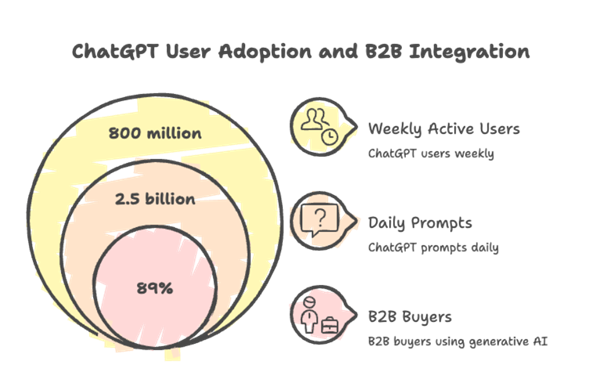
ChatGPT now boasts 800 million weekly active users, processing over 2.5 billion daily prompts. These aren’t just “What is the capital of France?” queries, they are high-intent commercial investigations.
In the B2B sector, the shift is even more pronounced. According to Forrester, 89% of B2B buyers now use generative AI throughout their entire buying process. They ask AI to compare software features, vet vendor reputations, and even draft RFPs.
If the AI doesn’t know you through its training data or Retrieval-Augmented Generation (RAG) processes, you don’t exist in the evaluation set. You are invisible before the race even begins.
The Paradox: Lower Traffic, Higher Quality
There is, however, a massive silver lining for those who adapt. While the quantity of clicks is down, the quality of the traffic that does arrive is higher than ever before. This is the Informed Visitor Effect.
Data from a Semrush study reveals shocking efficiency gain: Visitors arriving from AI sources convert 4.4x better than traditional organic traffic.
Why Does AI Traffic Convert?
When a user clicks a link cited in an AI Overview or a ChatGPT response, they aren’t just browsing. They have already been educated by AI. They’ve seen the summary, weighed the pros and cons, and are clicking on your link specifically to execute a transaction or download a deep-dive resource.
They arrive at your site with high intent, having already cleared the awareness and consideration hurdles of your sales funnel.
The AEO Strategy: How to Become the Answer
Winning in 2026 requires a transition from attracting clicks to earning citations.
If you cannot be the destination, you must at least be the source.
Here is the blueprint for a modern AEO strategy:
1.The Answer-First Content Structure
- Content Design
AI models are designed to find the path of least resistance. If your content is buried under 1,000 words of SEO filler, the AI will skip you.
- 50-Word Rule
Every high-value page should start with a concise 40–60-word direct answer to the primary question. This inverted pyramid style makes it easy for LLMs to scrape and cite your core thesis.
- Power of Micro-Data
Beyond standard SEO, you must use Schema.org markup aggressively. FAQ, How-To, Product, and Organization schema act as digital maps, allowing AI to parse your facts without guessing the context.
2. Prioritize Authority over Breadth
- Original Content
Generic “What is…” blog posts are being cannibalized by AI summaries. To stay relevant, you must provide what AI cannot: information gain.
- Proprietary Data
AI cannot hallucinate your internal case studies, proprietary surveys, or original research. In 2026, the most valuable asset a marketing team owns is its own data.
- The E-E-A-T Pivot
Google’s emphasis on Experience, Expertise, Authoritativeness, and Trustworthiness (E-E-A-T) is now the barrier to entry. Share “how we did it” (experience) rather than “how to do it” (theory). AI can generate theory—it cannot replicate experience.
3. Target Cited Visibility
- Entity Recognition
In the past, we optimized content for keywords. Now, we optimize for entity association. You want AI to associate your brand name (the entity) with a specific solution or category.
- Digital PR & Third-Party Validation
AI models trust information more when it is corroborated across multiple high-authority sources. Being mentioned in industry trade journals, Reddit discussions, and reputable news sites is now more important than having perfect on-page keyword density.
- Niche Dominance
It is better to be the definitive answer for a specific, narrow topic than a vague answer for a broad one. AI tends to cite specialists over generalists.
The New KPIs: Measuring Success in a Zero-Click World
The era of “traffic for traffic’s sake” is over. If you are still measuring success solely by sessions and pageviews, you are measuring a ghost.
In a zero-click world, the following are the KPIs that actually matter:
- Share of Model (SoM)
What percentage of the time does an AI model (such as ChatGPT or Google AIO) mention your brand when asked about your category?
- Citation Frequency
How often does your URL appear in the footnotes of AI-generated responses?
- Brand Search Volume
As users see your brand cited in AI answers, they will eventually bypass the AI and search for you directly.
- Conversion Rate by Source
This is the tracking of the 4.4X conversion multiplier from AI-referred traffic to justify the lower total volume.
In Conclusion
The market has shifted from a library of books to a panel of experts. In the library era, you just had to be a book on the shelf. In the expert era, you have to be the person the expert quotes to prove their point.
If you want your brand to be part of the conversation in 2026, you must stop trying to be a result and start being the answer. The click is dying. But the influence has never been more valuable.
Storyteller



Other posts
-



Saloni Peeti
- 19 Mar 2026
- 7 min read
-


Vandana Viswanath
- 16 Mar 2026
- 14 min read
-


Shakti Prasad
- 13 Mar 2026
- 7 min read