
Decoding the Core Differences Between SEO, GEO, and AEO
For over two decades, the digital marketing world revolved around a single acronym: SEO. If you wanted to be found, you optimized the search engine results page (SERP).
Today, the landscape has shifted drastically. We are no longer just searching by typing keywords into a white box; we are asking our watches for directions, prompting AI chatbots for summaries, and seeking hyper-local solutions in real time.
As we navigate 2026, a new vocabulary has emerged to define how brands stay visible. To master the modern web, you must understand the interplay between Search Engine Optimization (SEO), Generative Engine Optimization (GEO), and Answer Engine Optimization (AEO).
While they share the DNA of visibility, their mechanics, goals, and outcomes are worlds apart.
What Is SEO?
SEO is the veteran of the group. At its core, SEO is the process of optimizing a website to rank higher in traditional search engines such as Google or Bing.
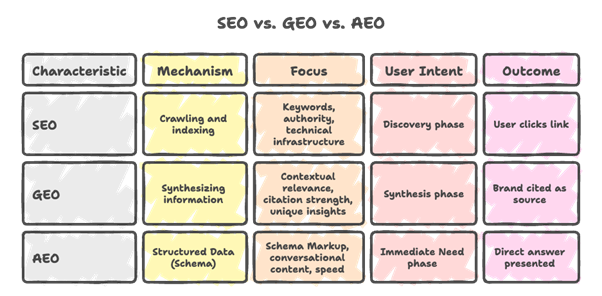
SEO relies on crawling and indexing. Search engines send bots to read your website’s code and content. They look for signals, keywords, backlinks, site speed, and mobile responsiveness, to determine where you sit in a list of blue links.
The focus is on the following aspects:
- Keywords
Identifying what users type
- Authority
Building backlinks from other reputable sites to prove your site is a trusted source
- Technical Infrastructure
Ensuring the site loads fast and has a clean sitemap
SEO serves intent across the full buyer journey—from early research to active comparison to purchase-ready queries. It’s not just about capturing browsers at the top of the funnel. The real win isn’t about the click. It’s about being the most useful, most trustworthy answer at every stage such that when a buyer is ready to act, your brand is already familiar.
What Is GEO?
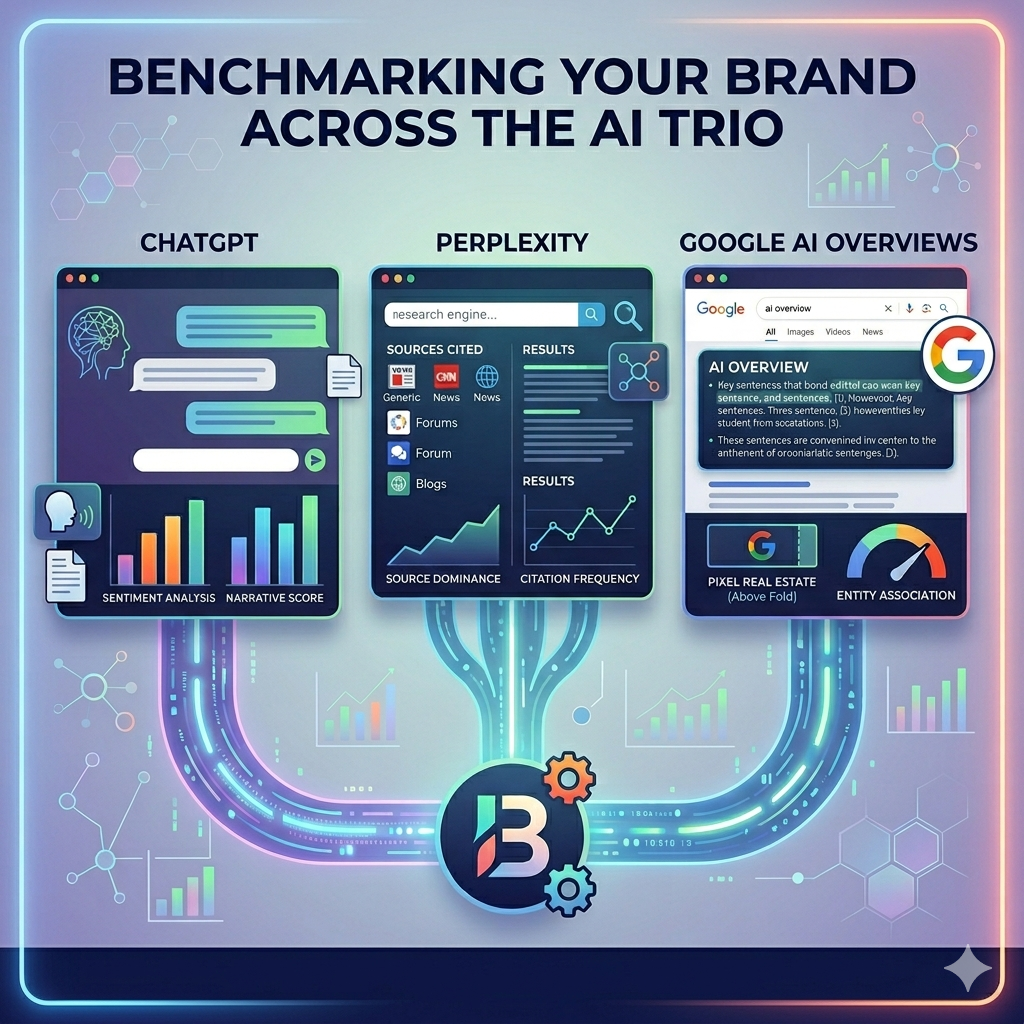
GEO is the practice of optimizing digital content to appear in AI-driven search results, such as ChatGPT, Google’s AI Overviews, and Gemini. Unlike traditional SEO, which focuses on ranking links, GEO aims for content to be cited, summarized, or quoted directly in AI-generated answers.
Generative engines don’t just provide a list of links; they synthesize information to create a unique, coherent response. GEO is the art of ensuring that information about your brand is included in that AI-generated summary.
The focus is on the following factors:
- Contextual Relevance
AI looks for entities and relationships.
- Citation Strength
Getting cited as a source within an AI’s paragraph is the new Ranking #1.
- Unique Insights
Generative engines value data, original research, and expert opinions that they can crunch into a summary.
GEO serves users who want synthesized, ready-to-use answers—not a list of links to sift through. But that behaviour isn’t limited to one stage of the journey. Whether someone is exploring a category, comparing solutions, or validating a shortlist, they’re increasingly asking AI to do the heavy lifting. The win isn’t just getting cited—it’s being the source the AI consistently pulls from, so your brand shows up no matter where the buyer is in their decision process.
What Is AEO?
AEO is often confused with GEO, but its scope is narrower and more immediate. AEO focuses on providing a direct, singular answer to a specific question. Think of Alexa, Siri, or Google’s Featured Snippets.
AEO thrives on Structured Data (Schema). It targets the Who, What, Where, and How questions.
The focus is on the following aspects:
- Schema Markup
Using specific code to tell engines: “This is a price”, “This is an FAQ”, or “This is a location”
- Conversational Content
Writing in a natural, Question-and-Answer format
- Speed and Conciseness
The answer, delivered in 2 or 3 sentences
AEO serves users who want a single, definitive answer delivered instantly—no browsing, no comparing, and often no screen at all. However, that behaviour isn’t confined to one moment in the journey. Someone asking “What is schema markup?” is exploring. Someone asking “How much does executive coaching cost?” is evaluating. Someone asking for “a restaurant’s number” is ready to act. All these three are answer-engine queries. The win is owning that zero-click moment—being the source that the engine trusts enough to generate as the answer, regardless of where the buyer is in their process.
We have covered all the questions and concepts of AEO in the guide: “The Definitive Guide to Answer Engine Optimization (AEO) for Enterprise Brands”
How They Work Together: An Example
Imagine a homeowner looking for a smart home automation provider.
- SEO’s Job
When a user types “best smart home installers near me,” SEO ensures that the provider appears on Page 1, so that the user can click to browse their portfolio and pricing.
- GEO’s Job
When a user asks an AI, “Which smart home systems are most compatible with solar energy storage?” GEO ensures the AI mentions the provider’s specific case studies on energy-efficient integration in its summary.
- AEO’s Job
When a user asks Alexa, “What is the warranty on a [Provider Name] installation?” AEO provides a direct, concise answer: “Five years for hardware and lifetime for labor,” instantly.
The Unified Strategy
The reality is that SEO, GEO, and AEO are not three separate workstreams to be managed in silos. If your content is semantically tight and your site holds genuine topical authority, it will naturally perform well across traditional search, answer engines, and AI-mediated discovery alike. You are building a single, robust information architecture, not running three parallel programs.
Most agencies mistakenly treat AEO as a “bolt-on” feature to be added after SEO is finished, but that is the wrong mental model. AEO is not an addition; it is what SEO becomes the medium evolves from ten blue links into generated answers.
Evidence in Action
Understanding the theory is one thing; seeing it impacts the bottom line is another.
At Toss the Coin, we have seen these strategies transform brand visibility through two distinct lenses:
The SEO Powerhouse: GMO for PE Case Study
Traditional and technical SEO still serve as the critical engine for traffic growth. In our Global Marketing Office for Private Equity (GMO for PE) project, we applied high-level technical optimization and strategic content repositioning.
- The Result
A massive 3x increase in website traffic and a 152% jump in engagement growth.
- The Lesson
Strategic technical optimization, the primary driver for capturing high-volume discovery intent
- The Reading
Learn more at Toss the Coin – GMO for PE Page
The AEO Manifesto: AI-Mediated Discovery
Our latest thought leadership piece, “ explores the shift into the “Dark Funnel.”
- Key Concept
As ChatGPT and other AI platforms become the primary discovery tools for B2B buyers, brands must pivot to AEO. It’s no longer enough to be a result; you must be the cited authority within the AI’s logic to exist in the buyer’s evaluation set.
- Full Insight
Read the: Heads Up Blog – B2B Marketing.
The Path Forward
An enterprise needs all three AI models for search visibility. If you only focus on SEO, you lose the massive audience moving toward AI-driven search. If you focus only on AEO, you might get answers, but no actual website traffic.
In 2026, this is what a winning digital strategy looks like:
- Build a Technical SEO Foundation so engines can find you.
- Create Expert-Led Content(GEO) that AI models would want to use as a primary source.
- Optimize Direct Answers(AEO) to capture the voice-search and mobile-first market.
Conclusion
The core difference lies in the user’s journey. SEO is about the Destination (visiting the site), GEO is about the Context (understanding the brand), and AEO is about the Resolution (getting the answer).
As search behavior becomes more fragmented, brands that adapt to all three pillars won’t just survive; they will dominate the conversation, whether that conversation is happening on a screen, through a speaker, or inside an AI’s logic.
Storyteller