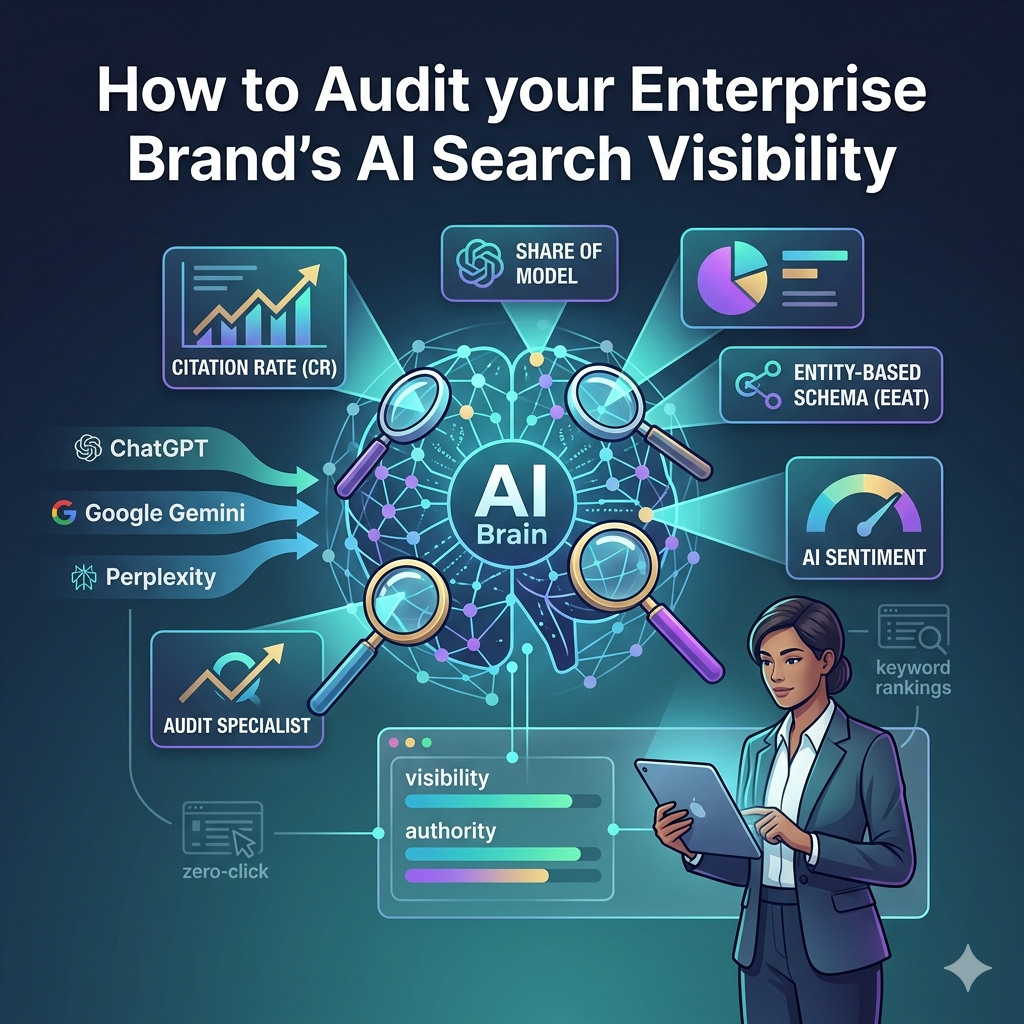
In an era of zero-click searches, ranking #1 is a vanity metric if an AI chatbot provides the answer without mentioning your brand. To stay visible, you must pivot to new KPIs: Citation Rate, which tracks how often you are a chosen source, and Share of Model (SoM), which measures your influence within the AI’s distilled truth.
To understand your visibility, you must shift to a completely different set of KPIs—moving from “Keyword Rankings” to Citation Rate and from “Organic Traffic” to Share of Model (SoM). This requires auditing how your brand is synthesized, not just where it is listed, as success is now defined by whether you are part of the AI’s “distilled truth” or excluded from the conversation entirely.
To bridge this gap, the audit begins by identifying Invisibility Gaps, where models might omit your brand from industry lists or use competitors to explain concepts you pioneered. This is often a failure of Information Gain; AI prioritizes sources that offer unique data and proprietary insights over those that simply rehash existing content. By strengthening your Technical Identity through nested Schema, linking your organization, experts, and products, you provide the structured metadata necessary for AI to verify your authority.
The rise of Answer Engine Optimization (AEO) and Generative Engine Optimization (GEO) has shifted the landscape of brand visibility. For enterprise brands, the goal is no longer just ranking on page one; it is becoming the definitive citation within AI-generated responses on platforms like ChatGPT, Perplexity, and Google’s Gemini. 50% of B2B software buyers now start their research journey in an AI chatbot rather than a traditional search engine. That is a 71% increase over late 2025.
This is the era of the “Distilled Truth.” AI models like ChatGPT, Perplexity, and Gemini act as the ultimate gatekeepers, condensing millions of data points into a single, authoritative summary. To survive, your brand must move from being a scattered data point on the web to becoming the definitive, trusted source that the AI chooses to cite.
Auditing your visibility is no longer about tracking blue links; it is a strategic mission to secure your Share of Model (SoM). This guide outlines the framework to move your brand out of the shadows and into the core of the AI’s synthesized reality.
This pillar blog outlines a strategic framework for auditing and improving your brand’s presence within the AI ecosystem. This guide breaks down the following questions and concepts:
- Establishing the Benchmark: The AI Share of Voice (SoV)
- Technical Infrastructure Audit
- Content Ecosystem & Knowledge Graph Alignment
- The Source Reliability Audit
- Gap Analysis: The Hallucination Risk
- Measuring Success: The Enterprise AI Framework
- Moving Forward: The “Human-in-the-Loop” Filter
Establishing the Benchmark: The AI Share of Voice (SoV)
AI Share of Voice (AI SoV) is a next-generation marketing metric that measures your brand’s visibility and influence within the synthesized answers generated by AI engines like ChatGPT, Perplexity, and Google Gemini.
Establishing the AI Share of Voice (SoV) is the cornerstone of any enterprise AI audit because it shifts the focus from “Where do we rank on a list?” to “How often are we the chosen answer?”
In a world where LLMs synthesize information into a single response, being “Result #4” is often the same as being invisible. Here is a deeper dive into how to establish this benchmark effectively.
1. AI Citation Gap Analysis: Finding Where Your Brand Is Invisible
AI Citation Gap Analysis is the process of identifying why AI systems omit your brand from the distilled truth. If an AI summarizes your entire industry and doesn’t mention you, or mentions you without citing you, you are effectively invisible to the next generation of buyers.
Traditional SEO focuses on where you rank; AI Citation Gap Analysis focuses on where you are excluded from the conversation. 58% of Google searches now result in zero clicks due to the presence of AI Overviews, while overall organic Click-Through Rate (CTR) is projected to decline by 25% by the end of 2026.
To find your invisibility gaps, segment your audit into prompt clusters:
The Category Gap
This occurs when an AI engine fails to include your brand in “best-of” or “top-tier” lists for your core industry.
The “Zero-Sum” Problem
Most AI responses only cite 3 to 5 sources. If you are the 6th most relevant brand, you receive zero visibility.
Audit Strategy
Run prompts like “Who are the leaders in [Category]?” or “Compare the top enterprise solutions for [Problem].”
Root Cause
A lack of Semantic Density. If the AI does not see enough high-authority third-party sites (Gartner, WSJ, niche journals) linking your brand to that category, it will not trust the association enough to include you.
_______________________________________________________________________________
The Informational Gap
This occurs when AI uses your competitors’ content to explain concepts – even if your product is superior.
The Expert vs. The Vendor: If an AI uses a competitor’s blog to define “How to scale cloud architecture,” that competitor becomes the expert in the AI’s Knowledge Graph, while you are relegated to being just another vendor.
Audit Strategy: Test high-intent informational queries like “How do I calculate ROI for [Industry Task]?” or “What are the security standards for [Technology]?”
Root Cause: A failure of information gain. If your content simply rehashes existing knowledge, AI has no reason to cite you. It prioritizes the “N-of-1” source – those offering unique data, proprietary research, or a novel framework. 44.2% of all LLM citations are pulled from the first 30% of a piece of content, specifically favoring information gain”signals like proprietary data.
___________________________________________________________________________________
The Unlinked Mention Gap
This is one of the most frustrating gap for enterprise marketers: the AI knows your brand and references it positively but does not link to your domain.
The Attribution Dead-End: This leads to “Zero-Click” search at its worst – users get value from your reputation, but traffic goes elsewhere.
Audit Strategy: Identify responses where the AI mentions your brand but links to third-party sites (e.g., Wikipedia, news articles) instead of your domain.
Root Cause: Often a technical infrastructure issue. Your schema (especially Organization and Product) may not clearly define the citation path back to your official URL. The AI understands your brand as a concept but not your site as the authoritative source.
_________________________________________________________________________________
Query Mapping
AI models interpret differently from a standard search engine. When mapping your queries, you aren’t just looking for keywords; you are looking for “Extraction Potential.”
Categorize queries into:
- Informational (“What is…”)
- Navigational (“Login to…”)
- Transactional (“Best enterprise software for…”).
The Citation Rate Metric
In the AI ecosystem, a mention is good for brand awareness, but a citation is the gold standard for SEO and attribution. Track how many times your domain is cited as a source versus how many times your brand name is mentioned without a link.
Sentiment Analysis
LLMs are trained on vast datasets, they inherit the collective opinion of the internet. An AI’s sentiment toward your brand is essentially a mirror of your digital PR. Use LLMs to analyze the tone the AI adopts when describing your brand.
We have explored AI Citation Gap Analysis: Finding Where Your Brand Is Invisible in another article to understand how organizations can become indispensable.
__________________________________________________________________________________
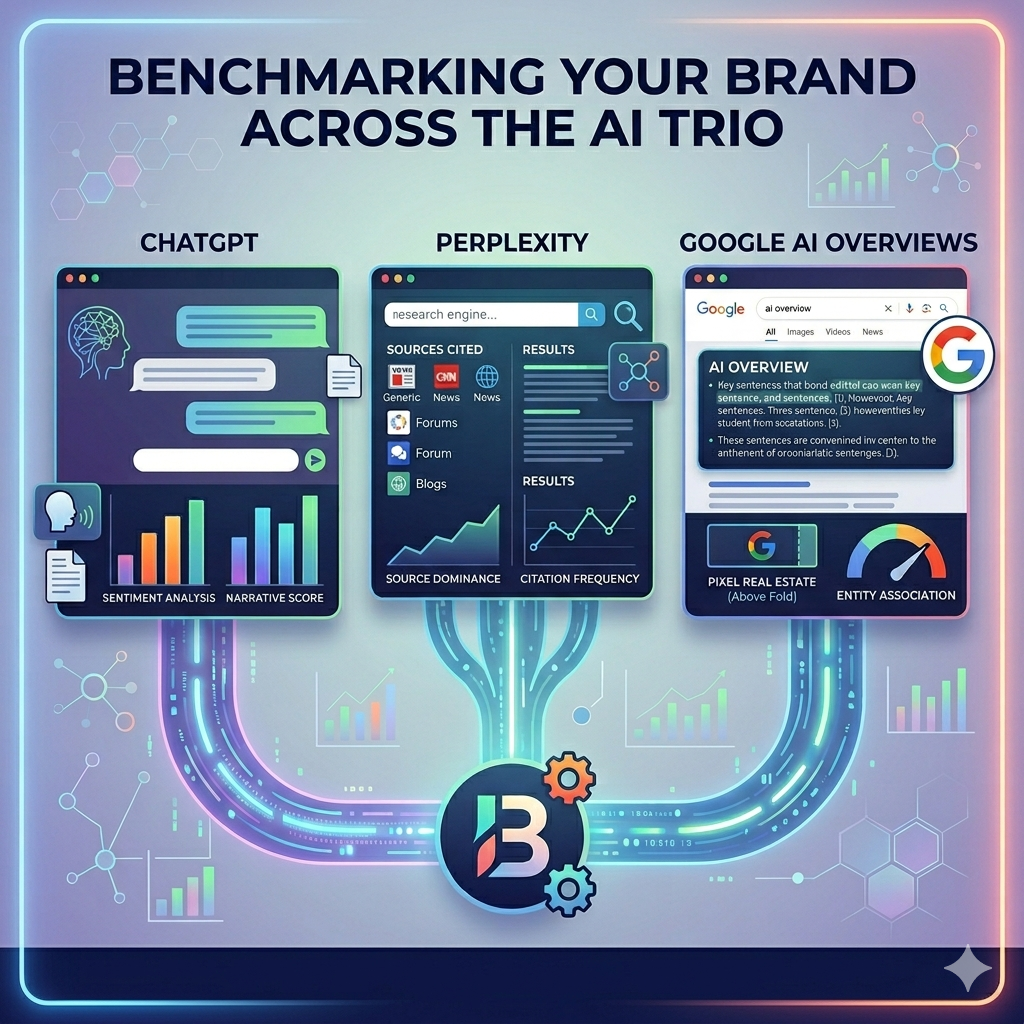
Benchmarking Across ChatGPT, Perplexity, and Google AI Overviews
Not all AI engines are created equal. Your audit must reflect how each model operates:
- ChatGPT (OpenAI): Relies heavily on pre-training data and knowledge graph connections. It views the internet like a historical record, prioritizing established reputation over temporary trends. Prioritizes established authority and encyclopedic sources (Wikipedia, Tier-1 media, journals).
- Perplexity AI: Perplexity is arguably the most transparent engine because it is built entirely around citations. It functions as a retrieval-augmented generation (RAG) specialist, prioritizing freshness and direct answers. Prioritizes recency and semantic clarity. Perplexity functions more like a real-time librarian. If your latest product launch is not being cited here, your crawlability formatting is likely the bottleneck.
- Google AI Overviews (AIO): Google AIO is the bridge between traditional search and generative AI. It is highly influenced by traditional SEO signals but filtered through an extractive lens. If you rank in the top three organic results but aren’t in the AIO, your content may be too dense. Google prefers structured data and concise answers for its synthesized summaries.
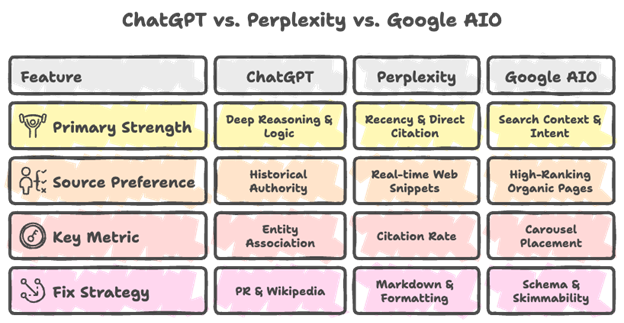
We have discussed the technical and strategic steps to audit and benchmark your brand across the Big Three of the AI era: ChatGPT, Perplexity, and Google AI Overviews in this article.
Technical Infrastructure Audit
In 2026, schema is no longer just for Google’s rich snippets. It is the structured language used to feed the Large Language Models (LLMs) that power the search triad: SEO, GEO, and AEO. If your website is the book, schema is the metadata that allows an AI to index your brand into its global Knowledge Graph.
To ensure your enterprise brand is not just crawled but understood, you must move beyond basic tagging and implement a nested, entity-based Schema strategy.
1. Organization + sameAs: The Identity Anchor
AI engines struggle with disambiguation – telling the difference between two brands with similar names. The Organization Schema is your brand’s birth certificate.
- The sameAs Property: This is the most critical field for AI. By listing your Wikipedia URL, LinkedIn Company Page, and official social handles, you are providing the AI with a “Verification Loop.” It allows the LLM to connect your website’s claims with the “Ground Truth” stored on authoritative third-party platforms.
- The logo and foundingDate: Providing clear, structured facts about your origin and branding helps the AI build a consistent “Entity Card” for your brand.
2. Person + knowsAbout: Establishing E-E-A-T
With the rise of AI slop, engines like Google and Perplexity are obsessed with Authoritative Verification. They want to know who is behind the content.
- The knowsAbout Field: This allows you to explicitly define the expertise of your C-suite and subject matter experts. For example, a Marketing Architect’s Schema should include knowsAbout: [“Generative Engine Optimization”, “B2B Branding”, “AEO”].
- The worksFor Property: By nesting your experts within your Organization Schema, you create a “Trust Cluster.” The AI learns that your brand is an authority because it employs verified experts. This significantly increases the likelihood of your executives being cited as “Key Thought Leaders” in AI summaries.
3. Product + AggregateRating: The “Safety” Signal
AI engines are designed to be “Helpful Assistants.” They are programmed to avoid recommending poor-quality solutions to users.
- The Confidence Score: Including AggregateRating and Review schema provides the AI with a mathematical reason to recommend you. If an AI has to choose between three CRM platforms to answer the prompt “What is the best CRM for small teams?”, it will prioritize the one with structured proof of high user satisfaction.
- Brand and Manufacturer: Explicitly nesting these within the Product schema ensures the AI doesn’t accidentally attribute your features to a competitor during a comparison prompt (avoiding the “Similarity Trap”).
4. FAQ & HowTo: The Extraction Points
Google AI Overviews (AIO) and Perplexity thrive on “Chunked Data.” They look for content that is already pre-formatted to answer a specific question.
- FAQPage Schema: This is the “AEO Goldmine.” By mirroring common user questions in your FAQ Schema, you are essentially hand-delivering a “ready-to-use” snippet to the AI.
- HowTo Schema: For technical or process-oriented enterprise brands, HowTo schema provides the step-by-step logic that AI models love to summarize. If your “How to Audit AI Visibility” guide uses this schema, the AI can pull the entire checklist directly into the search results, ensuring you own the “Position Zero” citation.
5. Technical Implementation: The “Connected Graph”
The real power of Schema in 2026 is Nesting. Do not just have five separate Schema blocks; link them together using @id references.
The Goal: You want the AI to see a single, unbroken chain: This Article was written by this Person (Expert in X), who works for this Organization (Industry Leader), which manufactures this Product (Highly Rated).
AI models crawl and process data differently than traditional bots. If your site architecture is opaque, the AI will bypass it.
Robots.txt & AI Permissions: In the past, robots.txt was a simple way to keep junk pages out of Google. Today, it is a strategic toggle for your brand’s “intelligence.” Review your permissions for crawlers like GPTBot or CCBot. While some enterprises block them for privacy, doing so may “blind” the AI to your most recent brand updates.
API Accessibility: Retrieval-Augmented Generation (RAG) is how AI models pull “live” data to answer specific questions. If your site structure is a maze of nested PDFs and JavaScript-heavy menus, RAG systems will fail to “retrieve” your information. For enterprise-level data, consider whether your public-facing documentation is accessible in formats that are easily digestible for RAG systems.
Content Ecosystem & Knowledge Graph Alignment
AI models don’t just look for keywords; they look for Entities and Relationships. An audit must ensure your brand is firmly planted in the global Knowledge Graph. To an AI, your brand isn’t a collection of keywords; it is an Entity, a distinct node in a giant web of facts known as a Knowledge Graph. If the AI cannot connect your node to other high-authority nodes (like your industry, your competitors, or your specific technology), you remain digitally anonymous.
- The “N-of-1” Authority Check: AI models are trained on the existing web; they don’t need you to tell them what they already know. They need Information Gain. Does your content provide unique data, proprietary research, or “Information Gain”? AI models prioritize sources that offer new information rather than rehashing existing web content.
- Entity Association Audit: Search for your brand alongside key industry terms. If the AI does not immediately associate your brand with your core product category (e.g., “Enterprise Cloud Security”), there is a gap in your content’s semantic density.
- Competitive AI Presence Mapping: is the process of reverse-engineering the Source Influence that anchors your rivals’ authority within AI models. By systematically querying the search triad – ChatGPT, Perplexity, and Google AI Overviews with industry-standard prompts, you can identify the specific Power Citation domains (such as Gartner, Reddit, or a competitor’s own technical blog) that the AI relies on to synthesize answers. This allows you to build a Context Map to see if rivals are being cited for product features, pricing, or thought leadership, ultimately generating a Steal List of high-authority third-party sites to target for PR and backlinks. By displacing a competitor’s content with your own more recent, data-dense Information Gain assets, you shift the AI’s trust toward your brand, effectively hijacking the source influence your rivals currently enjoy.
____________________________________________________________________________________
The Source Reliability Audit
In the AI era, trust is the primary filter for citation. AI models like ChatGPT and Perplexity do not treat all websites equally; they operate on a Hierarchy of Trust, where third-party validation often carries more weight than a brand’s own self-reported data.
A Source Reliability Audit ensures that the external signals about your brand are consistent, authoritative, and positive. If your brand is mentioned on Wikipedia, Tier-1 news outlets, and niche industry forums, your AI visibility will skyrocket.
- The Hierarchy of Trust: When an LLM synthesizes a response about your brand, it pulls from a weighted list of sources. To the AI, your website is a primary claim, but third-party sites are verification layers. These layers can be divided into three tiers.
Tier 1: High-Authority Truth Nodes: Such as Wikipedia, Britannica, and major news outlets (New York Times, Bloomberg). If your brand has a Wikipedia entry, the AI uses it as the ground truth for your history and founding facts.
Tier 2: Specialized Editorial: Such as industry-specific journals (e.g., TechCrunch for startups). Being cited here as an expert source makes you a safe citation for the AI.
Tier 3: Aggregated Peer Sentiment: This is where the AI learns your reputation.
- Third-Party Validation: In 2026, AI models don’t just look at star ratings; they perform Natural Language Processing (NLP) on the text of your reviews to understand your brand’s nuances. Platforms like G2 and Capterra (now under a unified data foundation) are massive training sets for B2B AI. If your software is consistently praised for “Ease of Use” but criticized for “Implementation Time” in G2 reviews, the AI will mirror those exact pros and cons in its summary. AI models look for patterns over perfection. If 500 people on Reddit and G2 say your customer support is slow, a single page on your website claiming “24/7 Award-Winning Support” will be treated as a low-confidence claim.
- Executive Thought Leadership: Google’s E-E-A-T (Experience, Expertise, Authoritativeness, Trustworthiness) has evolved into a system that tracks Individual Entities. AI models now connect a brand’s credibility directly to the verified expertise of its leaders. In early 2026, major search engines added “Author” sections to their technical documentation. An audit must ensure your C-suite has a “Digital Paper Trail”: consistent bios, LinkedIn profiles, and bylines on reputable sites. When the AI needs a credible opinion on a specific industry trend, it is more likely to cite a brand whose leaders are recognized as nodes of expertise in the Knowledge Graph.
_________________________________________________________________________________
Gap Analysis: The Hallucination Risk
A critical part of an AI audit is identifying where the AI gets it wrong. For an enterprise brand, a hallucination isn’t just a technical glitch; it is a reputational liability. When an LLM confidently states that your software lacks a feature it actually possesses, or cites pricing from 2022, it creates a frictional gap in the customer journey that traditional SEO cannot fix. Hallucination rates for major LLMs in structured enterprise analysis tasks still range between 15% and 52%.
A Hallucination Risk Audit is the process of identifying these logic leaps and deploying content to ground the AI in reality.
- The Anatomy of an AI Hallucination: To audit for hallucinations, you must understand why they happen. AI models operate on probability, not fact. If there is a Data Void: a lack of clear, recent, and consistent information, the AI will predict the most likely answer based on outdated or tangential data. Most LLMs have a knowledge cutoff. If you rebranded or launched a major pivot in the last 12 months, the AI may still be living in your past. This is known as the Training Data Lag. If your brand name is similar to another entity (e.g., a “Lotus” software vs. “Lotus” cars), the AI may conflate the two, attributing their features or history to you. Tis is known as the Similarity Trap. AI often simplifies complex enterprise pricing or service tiers. In this simplification, it frequently “invents” limitations or bundles that don’t exist, known as the Summary Bias.
- Inaccuracy Tracking: You cannot fix what you haven’t documented. Your audit should include a Hallucination Log across ChatGPT, Claude, Gemini, and Perplexity. This should include: Product Specs & Pricing – Does the AI accurately reflect your current SKU list? Common hallucinations include imagining a free tier that doesn’t exist or citing defunct enterprise modules. Leadership & Location – Check for Ghost Executives. AI often retains names of former CEOs or C-suite members long after they’ve departed. It also frequently hallucinates headquarters moves based on old office opening announcements. Comparison Hallucinations – When asked to Compare Brand X to Brand Y, AI models often struggle with nuance. Document instances where the AI claims a competitor has a feature you pioneered, or vice versa. Document instances where AI models provide outdated pricing, defunct product names, or incorrect headquarters locations.
- Corrective Content Strategy: If an AI consistently hallucinates about a specific aspect of your brand, it usually means there is a lack of clear, authoritative content on that topic. You must create The Definitive Guide to that specific sub-topic to override the noise. Once you identify a hallucination, you must provide the AI with a High-Confidence Anchor to override the error. This is not about more keywords; it is about Semantic Dominance.
- Content Vacuum Warning: A hallucination is almost always a sign of a Content Vacuum. If you aren’t telling your story clearly enough for a machine to understand, the machine will make one up for you. By auditing these risks, you identify exactly where your brand narrative has gone dark in the AI’s training set, allowing you to re-illuminate it with authoritative, RAG-ready content.
To override these noise-driven hallucinations, we deploy the Keystone 36 Content Framework. A systematic 6-cluster ecosystem designed to create high-density truth anchors for RAG systems.
____________________________________________________________________________________
Measuring Success: The Enterprise AI Framework
Tracking AI Search Performance represents the shift from monitoring clicks and impressions to measuring Share of Model. Because AI models like Perplexity and Google AI Overviews act as synthesizers, your success is no longer defined by your position in a list, but by your inclusion in the answer. To measure this, you must track three critical metrics:
- Citation Share, which calculates the percentage of industry-standard prompts where your domain is a primary source
- Referral Velocity, which monitors the rate of traffic growth coming specifically from AI referral strings (e.g., chatgpt.com or google.com AIO headers)
- Sentiment Alignment, which uses LLMs to audit whether the AI’s synthesized summary of your brand matches your intended positioning or is anchored in outdated hallucinated data.
To operationalize these metrics, utilize the Enterprise AI Visibility Scorecard provided below as a template for monthly pulse checks, ensuring your brand remains a high-confidence anchor in the global Knowledge Graph.
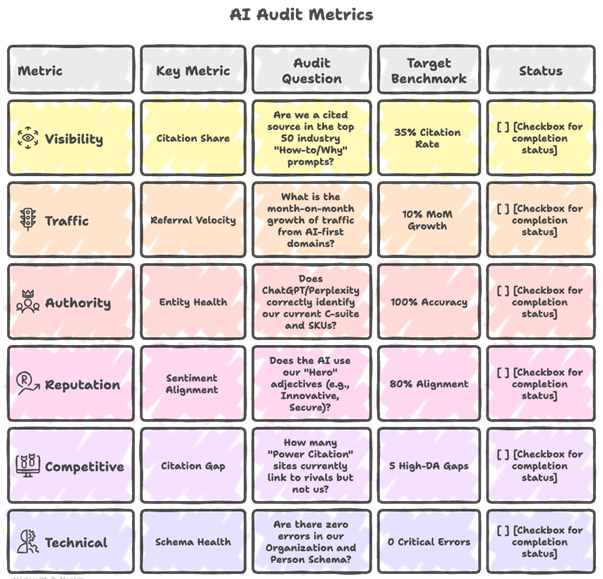
The Insight: This scorecard turns abstract AI behavior into a tangible report for stakeholders. By tracking these metrics, you move from guessing how AI sees your brand to strategically managing your influence across the generative search landscape.
Actionable Audit Checklist
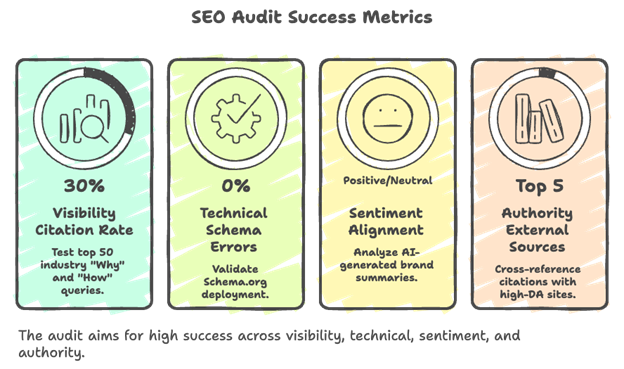
Moving Forward: The “Human-in-the-Loop” Filter
While the audit is technical, the solution is strategic. The taste gap is the difference between AI-generated mediocrity and high-impact brand storytelling. This is where enterprise brands win. Use the results of this audit not just to feed the machine, but to identify where your human experts need to provide deeper, more nuanced perspectives that AI cannot replicate on its own. Human-written, expert-led content acquires 61% more editorial backlinks than pure AI-generated content.
Auditing is the science, but content is the art. Once you find your gaps, fill them with content that is too high-quality for an AI to ignore. The Taste Gap is the difference between a generic AI answer and an expert-driven, data-backed human perspective. To win in AI search, don’t just provide data. Provide judgment.
Storyteller